.svg)

Inventory Optimisation: Closing the Loop Between Shelf and Supply Chain
May 9, 2026
For all the sophistication that sits in our forecasting tools, Enterprise Resource Planning (ERP) systems and planning models, there’s still one place where even the best-run supply chains can lose their footing: the store.
What’s on the shelf, in the backroom or on POS displays doesn’t always match what our systems think is available. That disconnect fuels phantom inventory, over- and under-ordering and ultimately, out-of-stocks (OOS) which erodes both sales and shopper trust.
At Neurolabs, we see this challenge every day. Brands spend millions fine-tuning their demand plans and optimising logistics, only to be blindsided by what’s actually happening at the shelf.
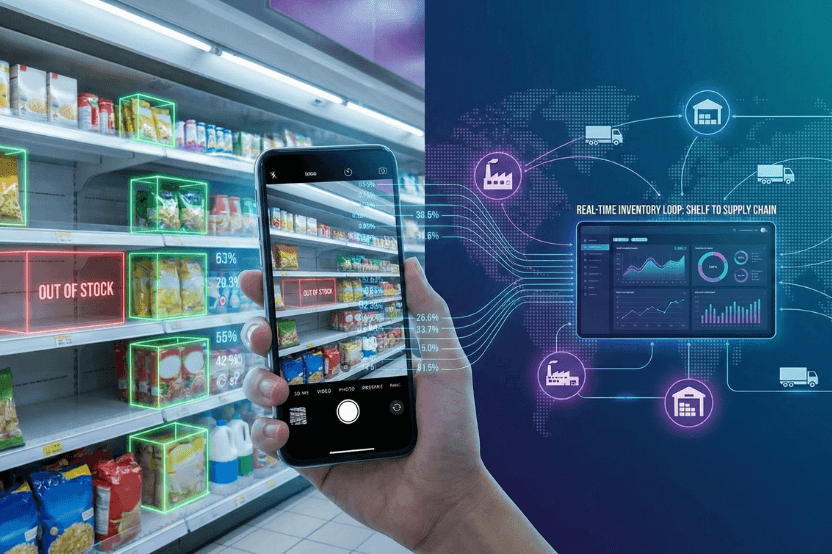
That’s where Image Recognition (IR) steps in, connecting what’s planned and shipped with what’s truly available to the shopper. It’s about giving your supply chain real eyes in-store.
The Business Problem
Even with all the right systems in place, teams still lack a true sense of on-hand reality.
Here’s what that looks like in practice:
- Phantom inventory: Systems show product on-hand, but the shelf is empty or stock is hidden somewhere in the backroom.
- E-commerce pick pressure: When a picker can’t find a product in-store, the order gets shorted or substituted. That’s a direct hit to both shopper experience and retailer margin.
- Backroom blind spots: Cases are sitting in the wrong bay or simply unaccounted for, delaying replenishment and skewing forecasts.
- Over/under-ordering: Store orders are based on outdated data, not what’s actually on the shelf today.
The outcome is familiar: lost sales, missed orders, wasted deliveries and increasingly, dissatisfied shoppers.
And as hybrid retail models expand, blending brick-and-mortar, direct-store-delivery (DSD), franchise and e-commerce fulfilment, the challenge is multiplying. More nodes, more partners, more chances for data to drift from reality.
The Quick Wins
What’s powerful about IR is how quickly it delivers value. With in-store photos captured through apps or field teams, you suddenly gain a real-time view of what’s on-shelf, off-shelf or out-of-stock.
Some of the fastest ROI cases we’ve seen come from:
- OOS & phantom inventory detection: Spot missing SKUs or facings across shelves and displays in near real time, backed by visual proof.
- Planogram-aware replenishment: Ensure store orders reflect the intended capacity, especially when promotional or seasonal displays shift shelf space.
- Backroom visibility: Understand what’s sitting in the backroom but not yet replenished, a classic “hidden OOS.”
- Overstock detection & rebalance: Identify where you’re heavy on inventory (or misplaced stock) and act before shrink sets in.
- Automated Image-to-Order (PicToOrder): When IR detects missing SKUs from shelf photos, it can trigger the next order automatically.
In practice: A beverage manufacturer now processes ~10,000 additional cases every week through Image-to-Order. The system identifies missing SKUs from shelf photos and injects them into the next delivery cycle. The result? A +1ppt lift in first-time-pick accuracy for online orders and a much smoother e-commerce fulfilment experience.
Building the Full Inventory Picture: Backroom, Shelf and Displays
The real step-change comes when you combine front-of-house and backroom visibility into a single source of truth.
- Backroom: The in-store buffer that often goes uncounted, creating hidden OOS.
- Shelf: What shoppers (and pickers) can actually see and buy, the ultimate test of availability.
- Displays & POS: Temporary but high-impact inventory that can dramatically skew velocity if not tracked.
Bringing these together creates a real-time, image-verified view of store-level inventory that’s more accurate than any system projection.
In practice: A global bottler added backroom visibility to its automated replenishment model. Combining shelf, display and backroom signals boosted replenishment accuracy from 89% → 91%. That 2-point gain translated into millions in recovered sales and a measurable lift in working-capital efficiency.
Distribution Visibility: The Missing Link
One of the more overlooked challenges sits in the distribution model itself.
CPG distribution is rarely linear anymore. Between direct-store-delivery (DSD), franchise and hybrid models and regional distributor networks, visibility tends to fracture the moment stock leaves the depot.
That’s where we see OOS issues spike. Product might be sitting in a distributor’s warehouse or on a delivery truck but at shelf level, it’s as good as gone.
Image Recognition brings this back into focus. Because it captures what’s actually happening in-store, it provides a neutral source of truth across every route-to-market, no matter how complex:
- For indirect models, IR validates that what’s been delivered downstream is truly reaching shelves.
- For hybrid networks, it enables consistent visibility across territories and partners.
- For DSD routes, it triggers on-the-spot replenishment or redistribution before shoppers ever notice a gap.
Distribution complexity no longer has to mean distribution blindness.
E-Commerce & Picker Guidance: The Modern Visibility Test
Click-and-collect and home delivery have redefined what “in-stock” really means. When a picker can’t find an item, it’s an OOS from the shopper’s perspective, even if stock exists in the backroom.
With IR integrated into store systems, pickers can:
- Be directed to exact backroom bays (e.g., “C8: 12 cases available”) to fulfil online orders.
- Avoid false OOS by confirming the product is present but misplaced.
- Improve “ready-for-pickup” reliability reducing substitutions, refunds and churn.
For omnichannel retailers, that’s no longer a nice-to-have. It’s a competitive necessity.
From Reactive to Predictive
Once image-verified inventory data starts flowing into ERP, Warehouse Management System (WMS) or order management systems, the game changes from reactive to predictive.
- AI-driven reorder triggers combine shelf and backroom visibility with promo, weather and velocity data to predict OOS before they happen.
- Root-cause analytics finally isolate whether a stockout was caused by poor planning, late delivery or execution issues in-store.
- Same-day ordering becomes a reality, powered by verified SKU-level accuracy at scale (>97%).
The result is a more agile, responsive supply chain. One that learns from the shelf up, not the system down.
Why This Matters
Inventory optimisation sits at the crossroads of growth, cost and trust.
- Growth, because every avoided OOS is a captured sale.
- Cost, because every corrected overstock or misdelivery prevents waste.
- Trust, because every image-verified replenishment strengthens retailer partnerships.
We talk a lot about “data-driven collaboration,” but this is where it really happens: when both supplier and retailer can see the same truth, in real time and act on it together.
That’s how the shelf finally connects to the supply chain and how the supply chain starts learning from the shelf.
Next in the Series
This article is part of our ongoing series exploring the Four Strategic Levers of Retail Execution in 2025.
If you missed the earlier instalments, start with From Compliance to Growth: Why Smarter Audits Drive Retail Execution, where I explored how intelligent audit automation drives visibility and speed across the shelf.
Then check out Field Force Optimisation: From Data Collectors to Sales Drivers, which looked at how Image Recognition empowers field teams to focus on action, not admin.
In this piece, we’ve shifted focus to Inventory Optimisation, where connecting shelf visibility to the supply chain helps close the loop between what’s planned, shipped and sold.
Next, I’ll explore Commercial Strategy, where retail execution meets trade ROI, category growth and innovation tracking.

Related Resource

%20(1).png)
.svg)
Get the latest Execution Intelligence news and resources direct to your inbox
Industry insights, retail intelligence and field-tested execution playbooks, so you always know what's happening in store.
.png)

.svg)

© 2026 Neurolabs. All rights reserved

