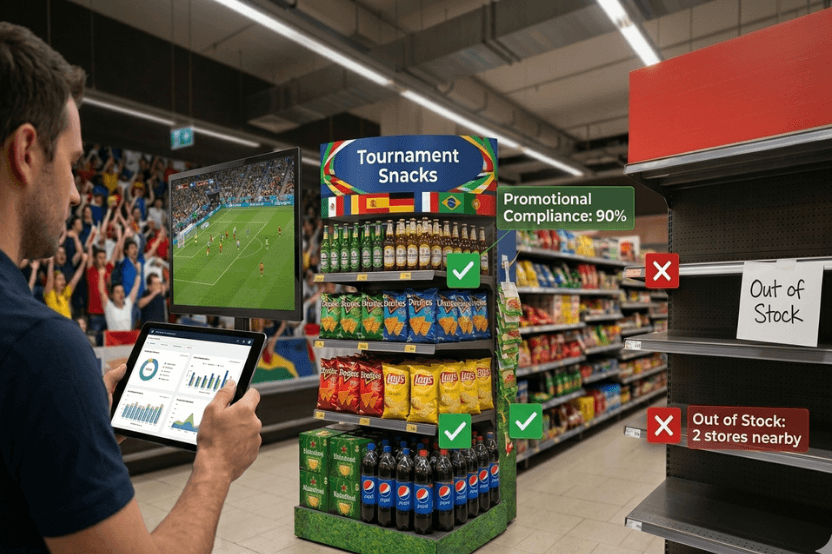
From the Aisle to the Algorithm: What POI Dallas 2025 Revealed About the New Era of CPG Execution

By
Remus Pop, CRO
09
Dec 2025
6
min read
Link copied!
TL;DR
  • Retail execution has become a strategic priority, with brands seeking to connect what happens on the shelf directly to financial outcomes.
  • The execution data gap is widening. Teams lack real-time, reliable, store-level visibility to validate promotions, optimise trade spend or guide field reps.
  • Visual AI emerged as a central theme, seen as the most scalable way to deliver accurate, structured, in-store data that integrates across Sales, RGM, TPM and Supply Chain.
  • Field forces are being redesigned, shifting reps away from manual auditing toward higher-value, guided selling supported by automated insights.
  • TPM teams want trusted, actionable execution data to validate spend, reduce deductions and tie activity to ROI.
  • The winners in 2026 and beyond will be those who unify execution, commercial and financial data into one connected decision-making loop, not those who simply collect more information.

If the last few years were about proving the value of data-driven retail execution, POI Dallas 2025 made one thing clear: the industry has officially moved into its operationalisation era. Most brands no longer question whether they need better execution visibility, the new challenge is how to embed it deeply enough across Sales, Revenue Growth Management (RGM), Supply Chain and Commercial teams to drive measurable financial outcomes.

Across three days of conversations with leaders in RGM, Trade Promotion Management (TPM) and Field Execution, one theme stood out above all: retail execution is finally being treated as a strategic discipline, not a reporting function.

Below are the biggest takeaways shaping the next decade of CPG performance.

1. Everyone Wants To Connect the Shelf to the P&L but the Data Gap Is Widening

A surprising number of teams shared the same frustration: despite major investments in digital transformation, they still lack real-time visibility into what's happening on the shelf.

Promotional ROI is slipping. Execution gaps remain persistent. Bill-backs and trade deductions continue to balloon. And without timely, granular in-store data, organisations are forced to rely on averages, assumptions or what happened last quarter.

POI reiterated this in its sessions: trade spend efficiency can’t improve until execution accuracy improves. And execution accuracy can’t improve without a reliable, scalable source of truth from the shelf.

This is exactly why Visual AI was such a dominant topic this year — not as a "cool new technology", but as the missing operational ingredient that unlocks the insights TPM and RGM teams have been trying to access for years.

2. Field Execution Is Being Redesigned Around Productivity Not Policing

The evolution of the field force came up time and time again: teams are becoming smaller, more skilled and more ROI-oriented.

Brands are shifting away from using reps as “data collectors”, a theme echoed in our Field Force Optimisation work, and instead empowering them as growth operators who:

  • Fix execution gaps in real time
  • Prioritise high-opportunity stores
  • Follow guided actions rather than static checklists
  • Spend less time documenting and more time selling

This is only possible when reps receive instant intelligence from the shelf, not reports processed hours or days later.

At POI, the message was clear: companies that automate data collection will reallocate 30–50% of rep time toward high-value activities, a transformation we’re already seeing in the field.

3. TPM Teams Are Desperate for One Thing: Trusted, Structured, Store-Level Data

One of the strongest signals from POI this year was the urgency around connecting execution data to trade spend decisions.

TPM leaders repeatedly asked the same questions:

  • How do I validate that what I paid for actually happened?
  • How do I link execution quality to promotional ROI?
  • How do I stop deductions from spiralling?

Many acknowledged that without objective shelf data, a significant percentage of spend is effectively unverified, this is consistent with what we outline in The Four Strategic Levers of Retail Execution.

Visual AI, synthetic data and digital twins were highlighted as emerging solutions because they provide auditable evidence of execution, bridging the long-standing gap between Sales and Finance.

The direction of travel is clear: trade optimisation will soon depend as much on shelf reality as it does on Electronic Point of Sale (EPOS).

4. The Future Belongs to Companies That Unify Their Data, Not Just Collect More of It

Something fascinating emerged at POI this year: brands aren’t asking for more dashboards, they’re asking for alignment.

  • Alignment between Sales and RGM
  • Alignment between in-store actions and headquarter decisions
  • Alignment between visibility and accountability

POI’s 2025 Vendor Panorama echoed this shift: the most valuable technology is the kind that connects operational data to financial outcomes, eliminating silos and creating a shared execution language.

This is exactly the architectural shift we describe in From Silos to Synergy: How Visual AI Is Unifying the CPG Tech Stack.

What This Means for the Next 12 Months

Based on the discussions at POI Dallas 2025, here’s where the industry is undeniably heading:

1. Trade Spend Efficiency will hinge on execution accuracy

Brands will tie spend to in-store reality with significantly more rigour.

2. Field forces will be restructured around automation and guidance

Manual auditing will be replaced by Visual AI, enabling reps to focus on value creation.

3. Image Recognition will become a strategic data source

Not just for compliance, but for demand forecasting, Joint Business Planning (JBP) negotiations, replenishment and commercial planning, mirroring the multi-lever impact outlined in our retail execution framework.

4. SKU volatility will force the industry to adopt synthetic data

Fast-moving pack changes and promotional cycles make manual catalogue work unsustainable, synthetic data solves this at scale.

Final Thought: Retail Execution Is No Longer a Downstream Activity, It’s the Strategic Centre of CPG Growth

POI reinforced the shift we’ve been championing for years: the brands that win are those who treat shelf execution not as an operational burden, but as a growth engine.

And that engine only works when powered by accurate, real-time, actionable data.

It was a privilege to share our perspective at POI Dallas and to see Visual AI recognised as a pivotal technology for the future of TPM and RGM. The momentum is unmistakable and we’re just at the beginning of what's possible.

Next Steps

If your team is exploring how to connect shelf execution to measurable commercial outcomes, we’d be glad to show you what’s possible.

Book a conversation with us, and let’s explore how Visual AI can unlock the visibility, speed and accuracy your organisation needs to grow in 2026 and beyond.

Remus Pop, Co-Founder & CRO

TL;DR
  • Retail execution has become a strategic priority, with brands seeking to connect what happens on the shelf directly to financial outcomes.
  • The execution data gap is widening. Teams lack real-time, reliable, store-level visibility to validate promotions, optimise trade spend or guide field reps.
  • Visual AI emerged as a central theme, seen as the most scalable way to deliver accurate, structured, in-store data that integrates across Sales, RGM, TPM and Supply Chain.
  • Field forces are being redesigned, shifting reps away from manual auditing toward higher-value, guided selling supported by automated insights.
  • TPM teams want trusted, actionable execution data to validate spend, reduce deductions and tie activity to ROI.
  • The winners in 2026 and beyond will be those who unify execution, commercial and financial data into one connected decision-making loop, not those who simply collect more information.

If the last few years were about proving the value of data-driven retail execution, POI Dallas 2025 made one thing clear: the industry has officially moved into its operationalisation era. Most brands no longer question whether they need better execution visibility, the new challenge is how to embed it deeply enough across Sales, Revenue Growth Management (RGM), Supply Chain and Commercial teams to drive measurable financial outcomes.

Across three days of conversations with leaders in RGM, Trade Promotion Management (TPM) and Field Execution, one theme stood out above all: retail execution is finally being treated as a strategic discipline, not a reporting function.

Below are the biggest takeaways shaping the next decade of CPG performance.

1. Everyone Wants To Connect the Shelf to the P&L but the Data Gap Is Widening

A surprising number of teams shared the same frustration: despite major investments in digital transformation, they still lack real-time visibility into what's happening on the shelf.

Promotional ROI is slipping. Execution gaps remain persistent. Bill-backs and trade deductions continue to balloon. And without timely, granular in-store data, organisations are forced to rely on averages, assumptions or what happened last quarter.

POI reiterated this in its sessions: trade spend efficiency can’t improve until execution accuracy improves. And execution accuracy can’t improve without a reliable, scalable source of truth from the shelf.

This is exactly why Visual AI was such a dominant topic this year — not as a "cool new technology", but as the missing operational ingredient that unlocks the insights TPM and RGM teams have been trying to access for years.

2. Field Execution Is Being Redesigned Around Productivity Not Policing

The evolution of the field force came up time and time again: teams are becoming smaller, more skilled and more ROI-oriented.

Brands are shifting away from using reps as “data collectors”, a theme echoed in our Field Force Optimisation work, and instead empowering them as growth operators who:

  • Fix execution gaps in real time
  • Prioritise high-opportunity stores
  • Follow guided actions rather than static checklists
  • Spend less time documenting and more time selling

This is only possible when reps receive instant intelligence from the shelf, not reports processed hours or days later.

At POI, the message was clear: companies that automate data collection will reallocate 30–50% of rep time toward high-value activities, a transformation we’re already seeing in the field.

3. TPM Teams Are Desperate for One Thing: Trusted, Structured, Store-Level Data

One of the strongest signals from POI this year was the urgency around connecting execution data to trade spend decisions.

TPM leaders repeatedly asked the same questions:

  • How do I validate that what I paid for actually happened?
  • How do I link execution quality to promotional ROI?
  • How do I stop deductions from spiralling?

Many acknowledged that without objective shelf data, a significant percentage of spend is effectively unverified, this is consistent with what we outline in The Four Strategic Levers of Retail Execution.

Visual AI, synthetic data and digital twins were highlighted as emerging solutions because they provide auditable evidence of execution, bridging the long-standing gap between Sales and Finance.

The direction of travel is clear: trade optimisation will soon depend as much on shelf reality as it does on Electronic Point of Sale (EPOS).

4. The Future Belongs to Companies That Unify Their Data, Not Just Collect More of It

Something fascinating emerged at POI this year: brands aren’t asking for more dashboards, they’re asking for alignment.

  • Alignment between Sales and RGM
  • Alignment between in-store actions and headquarter decisions
  • Alignment between visibility and accountability

POI’s 2025 Vendor Panorama echoed this shift: the most valuable technology is the kind that connects operational data to financial outcomes, eliminating silos and creating a shared execution language.

This is exactly the architectural shift we describe in From Silos to Synergy: How Visual AI Is Unifying the CPG Tech Stack.

What This Means for the Next 12 Months

Based on the discussions at POI Dallas 2025, here’s where the industry is undeniably heading:

1. Trade Spend Efficiency will hinge on execution accuracy

Brands will tie spend to in-store reality with significantly more rigour.

2. Field forces will be restructured around automation and guidance

Manual auditing will be replaced by Visual AI, enabling reps to focus on value creation.

3. Image Recognition will become a strategic data source

Not just for compliance, but for demand forecasting, Joint Business Planning (JBP) negotiations, replenishment and commercial planning, mirroring the multi-lever impact outlined in our retail execution framework.

4. SKU volatility will force the industry to adopt synthetic data

Fast-moving pack changes and promotional cycles make manual catalogue work unsustainable, synthetic data solves this at scale.

Final Thought: Retail Execution Is No Longer a Downstream Activity, It’s the Strategic Centre of CPG Growth

POI reinforced the shift we’ve been championing for years: the brands that win are those who treat shelf execution not as an operational burden, but as a growth engine.

And that engine only works when powered by accurate, real-time, actionable data.

It was a privilege to share our perspective at POI Dallas and to see Visual AI recognised as a pivotal technology for the future of TPM and RGM. The momentum is unmistakable and we’re just at the beginning of what's possible.

Next Steps

If your team is exploring how to connect shelf execution to measurable commercial outcomes, we’d be glad to show you what’s possible.

Book a conversation with us, and let’s explore how Visual AI can unlock the visibility, speed and accuracy your organisation needs to grow in 2026 and beyond.

Remus Pop, Co-Founder & CRO

What you'll find inside: