

Who Owns the Image? Why Data Governance Now Matters as Much as Accuracy

November 24, 2026
Chapter four of the Execution Gap series. The earlier chapters mapped how the gap looks in different markets and this one covers a question we now hear in every region.
- Chapter one: Why the execution gap looks different in every market
- Chapter two: Latin America, the channel you can't see
- Chapter three: Europe, where nobody measures it the same way twice
- Chapter four: Who owns the image? (you are here)
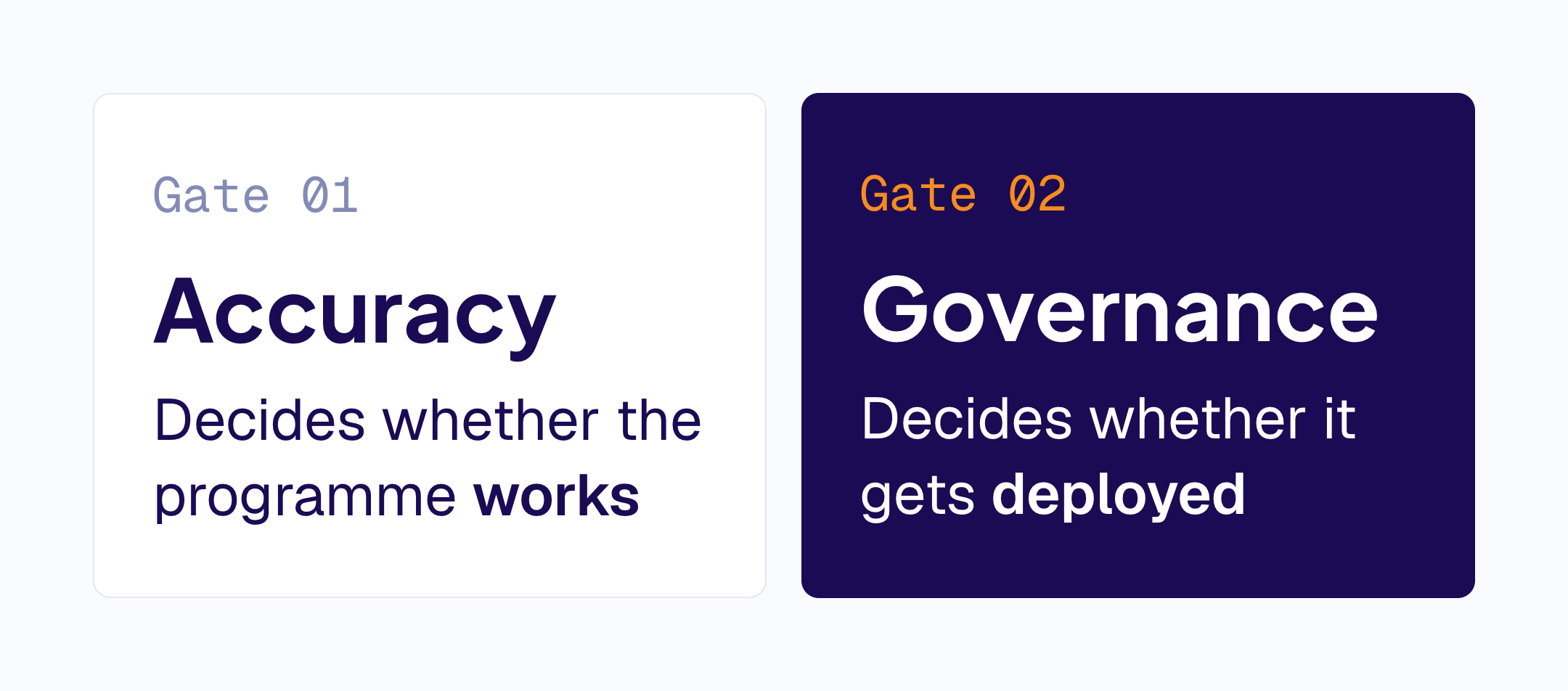
Two gates, not one
Every vendor conversation used to build towards one question: how accurate are you? That question has not gone away and it should not, because accuracy is the cornerstone of everything built on top of it. Every compliance score, every next-best action and every trade spend decision downstream is only as good as the recognition layer underneath it, while holding accuracy across millions of real store images is still hard.
What has changed is that accuracy now has company. In deal after deal a second question arrives alongside it, often in the same meeting: where do the images go, who keeps them and who owns what is derived from them?
Two years ago that question surfaced in a security review after commercial agreement, whereas now the commercial buyer raises it in the first or second meeting because many have already been burned.
One beverage group we spoke to had invested heavily in an integration with a previous vendor that it was never able to use, so full ownership of its images and the data derived from them is now a hard requirement that lets it bring everything into its own data lake and build its own reporting. A large Latin American manufacturer cut a previous image recognition supplier for a similar reason: the use case was proven and the commercials were fine, but the supplier's data model was the deal-breaker.
Neither buyer has stopped caring about accuracy; they have simply stopped treating it as the only question. A vendor with excellent recognition and weak governance does not get deployed, while a vendor with strong governance and weak recognition is not worth deploying. Both are now critical.
Why it is getting sharper
Store photos are no longer treated as disposable operational exhaust, because a single shelf image carries your pricing, your promotional mechanics, your distribution, your competitors' pricing and a read on shopper behaviour in that outlet. Aggregate a few million of them and you have one of the more commercially sensitive datasets the company owns, assembled by people who were thinking about compliance scores.
Four forces are pushing in the same direction.
Security teams caught up. Image data used to fall outside the classification schemes that govern customer records and financials, but it no longer does. Once store photos are classified as proprietary commercial data, the standard third-party controls apply.
Regulation is tightening everywhere. Europe's GDPR, Brazil's LGPD and data protection regimes across Latin America and Asia-Pacific all raise the cost of moving data across borders and of holding it loosely. Because staff and shoppers appear in store images, they sit close enough to personal data that legal teams apply the strict reading rather than the convenient one.
The bigger the buyer, the earlier it lands. At a multinational with a global technology function the question arrives before the first demo, because a global standard already exists and the local team cannot waive it. One global confectionery manufacturer made it clear that a successful pilot is not enough to expand into new markets, since any vendor also has to pass its security certification.
Data platform teams want one copy of the truth. Manufacturers that have spent years building a data platform do not want their most valuable new dataset living in a vendor's environment first. A European spirits group is designing its commercial data estate around a zero-copy principle that keeps data movement and duplication between systems to a minimum, so a vendor that insists on being the system of record does not fit, however accurate it is.
The same question, in every region
We see this in every market we work in: the wording changes but the question does not.
Oceania. Buyers running formal evaluations are writing ownership of images and derived data into their requirements, with raw data delivered into their own platform rather than pre-built KPIs.
United States. A fast-growing beverage brand paused the commercial conversation to hold a dedicated session on where its data would be stored, whether it would be shared and whether its images would quietly enrich the vendor's wider platform.
Europe. A spirits group is building around zero-copy data architecture, while a confectionery multinational discovered it does not hold the images its own store audits are based on (more on that below).
Latin America. A dairy manufacturer chose to have raw output delivered into its own data platform, with full control over how it is measured and visualised. At a regional consumer goods group, IT sign-off sat in the contract path alongside business and legal approval rather than after it.
Different markets, same instinct: the buyer wants to know whether adopting image recognition means handing a strategic dataset to someone else.
The photos you paid for and never saw
Here is the uncomfortable part: many brands already have a custody problem and do not think of it as one.
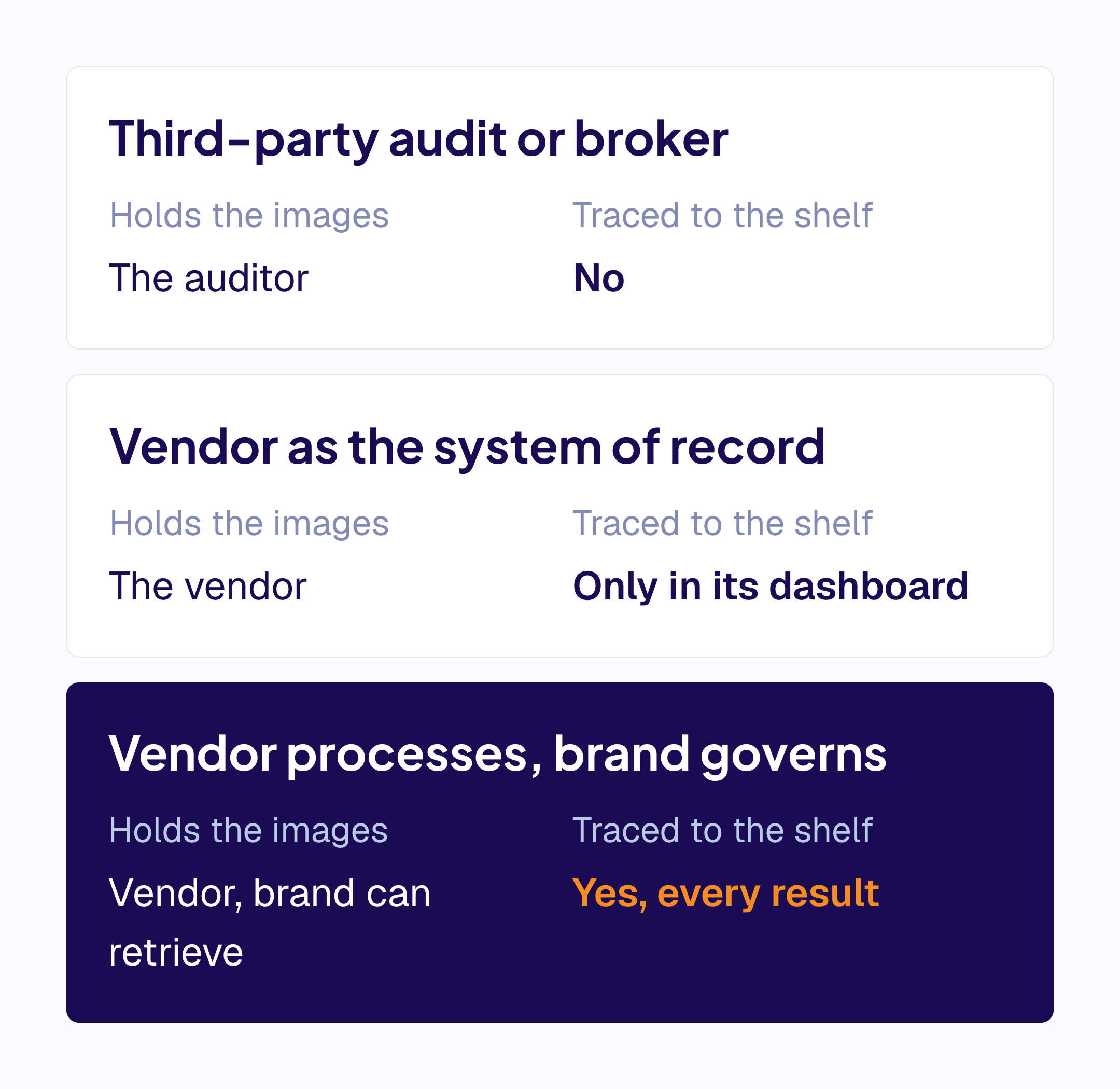
If your store execution data comes from a third-party audit or a broker, the photos were taken on your behalf in your stores and about your products, yet you almost certainly do not hold them because all you receive is a score. One European confectionery multinational told us it receives the final values from its audits but never the images behind them, even when the auditor uses image recognition to produce them.
That matters for the execution gap, because a score you cannot trace back to the shelf is a score you cannot challenge, re-read when you add a new KPI or join to your own sales data. It is the month-old audit problem with a second lock on it: late and closed.
So the ownership question is not only "will a new vendor take our images away from us?" but, for a lot of brands, "when do we finally get them back?"
What good looks like
Good governance starts with knowing what a store photo turns into. A vendor has to receive and process images to read them, so that is not the issue. The issue is what happens next and whether the buyer can see it.
Follow one photo through a programme and four things come out of it.

The image itself. It is the evidence behind every number, so the brand should be able to get back to it whenever a score is questioned.
The structured results. SKU, facings, price, promotion and position are the data the business runs on. They belong in the brand's own data platform, delivered raw through a governed share, where the brand's own teams decide what the KPIs are.
The catalogue. These are the product definitions the recognition is matched against, covering your products, packs and variants. The catalogue is specific to one customer and should stay that way, never used for another customer unless the brand agrees.
What the model learns. Recognition models get better by learning from the images they process, ours included, which is how accuracy holds across millions of real store images. What they learn is general (what shelves, packs, price tags and promotional material look like), while the brand's catalogue and results sit outside that.
A vendor with good governance can tell you which of the four it holds, which it passes to you and which stay separate from every other customer.
The commercial consequences are the ones that matter.
IT signs off instead of blocking. The security review becomes a permissions conversation rather than an architecture argument, which is often the difference between an approval and a dead deal.
The data stays useful for everything else. Output in your own platform can be joined to sales, trade and supply chain data, re-read for a new KPI or reprocessed when the catalogue expands, whereas data sitting in a vendor's environment is only available for the purposes that vendor supports.
You own the definitions. When raw output lands in your platform, your RGM, trade and sales teams define compliance their way and the vendor stops being the arbiter of what "good execution" means.
Switching costs stay honest. A vendor that owns several years of your store images holds a lever in every renewal, which makes ownership a negotiating position as well as a compliance one.
None of this replaces accuracy, because governance without accurate recognition just gives you clean ownership of bad data. The programmes that work deliver both: a read you can trust and data you control.
How it works: from a store photo to your data platform
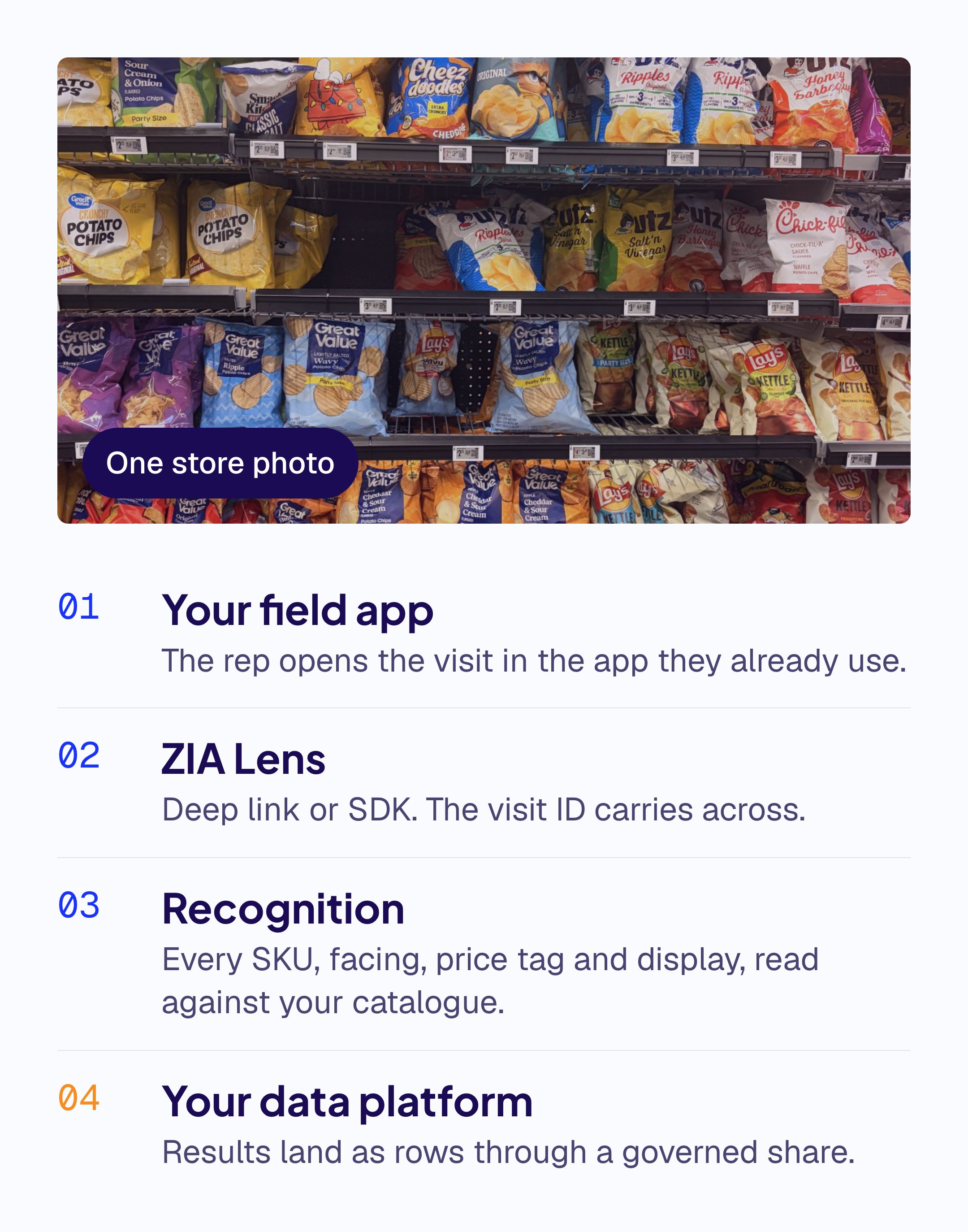
A rep opens the visit in the field app they already use and ZIA Lens either opens from it by deep link or sits inside it through the SDK. Either way the visit ID carries across so nothing is typed twice. Recognition reads every SKU, facing, price tag and display against your catalogue and each result keeps the visit ID, before landing as rows in your own data platform through a governed share where they join your visit and store data.
The questions worth asking any vendor
Ask these alongside the accuracy questions you already ask, not instead of them.
- What happens to one of our store photos after it is taken? Where is it processed and what is created from it?
- What do we receive: raw structured output in our own data platform, or scores in your dashboard?
- Can we trace any score back to the image behind it?
- Who defines the KPIs, you or us?
- How do you keep our catalogue and our results separate from every other customer's?
- How do your models learn and what do they learn from our images?
- How do we get our images and results out when we want them?
- Which of the above changes if we scale from one market to ten?
If the answers require a follow-up call with someone not in the room, the vendor's governance is probably not designed for this and you will find that out during the security review instead.
FAQ
What is data governance in retail image recognition?
It is the set of rules for what happens to a store photo and everything produced from it: who can see the image, what is derived from it, where the results flow, who defines the KPIs and what stays separate between one customer and the next.
Is accuracy still the most important criterion for image recognition?
Accuracy is still critical, because every insight, action and spend decision downstream depends on it and holding it at scale across real stores is still hard. What has changed is that data governance now sits alongside it as an equal criterion, so a vendor that fails either one does not get deployed.
Why do CPGs care who owns store images?
Because a store image is proprietary commercial data rather than an operational by-product, revealing your pricing, your promotional execution, your distribution and your competitors' activity in a specific outlet on a specific day. Security teams now classify it accordingly, regulators in many markets treat cross-border transfer as a risk to be justified and commercial teams have realised the dataset is worth owning outright.
What is the difference between data residency and data ownership?
Residency is about where the data sits, while ownership is about who controls it: who can re-use it, who defines the KPIs built on it and what happens to it when the contract ends. A vendor can keep images in-country and still own them in every way that matters, which is why buyers increasingly ask for both.
Does an image recognition vendor need to own your images to read them?
No. A vendor has to process an image to read it, but processing is not ownership. The output is structured data (SKU, facings, price, promotion, shelf position) that is smaller, more useful and less sensitive than the photo, so it belongs in your data platform. What separates vendors is what happens around that: whether you can get to your images and results, whether your catalogue stays yours alone and whether you or the vendor decide what the KPIs mean.
Do image recognition models learn from your store images?
They can and it is worth asking how. A recognition system learns in two places: the general layer learns what shelves, packs, price tags and promotional material look like from the images it processes, while the specific layer is your catalogue of products, packs and variants. The first is shared ability and the second should stay yours alone.
Do brands using third-party retail audits own their store images?
Usually not. Most audit and broker models deliver scores or summary values and keep the underlying photos, so the brand cannot re-read them, verify them or join them to its own data.
Does strong governance slow deployment down?
In most cases it does the opposite. Programmes that answer the governance questions up front start their security review already answered and go live faster than programmes that have to renegotiate terms after commercial agreement.
Data table
| Model | Who holds the images | What the brand receives | Who defines the KPIs | Can a score be traced to the shelf |
|---|---|---|---|---|
| Third-party audit or broker | The auditor | Scores and summary values | The auditor | No: the brand never sees the images |
| Vendor as the system of record | The vendor | Dashboard KPIs | The vendor | Only inside the vendor's dashboard |
| Vendor processes, brand governs | The vendor processes them and the brand can retrieve them | Raw structured output in its own data platform | The brand | Yes: each result links back to its image |
You can't close a gap you can't see. Start by measuring yours.
The Execution Gap: 2026 Execution Intelligence Guide pulls the full picture together: what the gap costs the industry, why month-old audits keep missing it and what closing it looks like across shelf visibility, promotions and pricing.

Related Resource



Get the latest Execution Intelligence news and resources direct to your inbox
Industry insights, retail intelligence and field-tested execution playbooks, so you always know what's happening in store.



© 2026 Neurolabs. All rights reserved

