.svg)

Why Neurolabs' Computer Vision Technology Triumphs Over Amazon's Tech Tactics
May 9, 2026
Just a few years ago, Amazon's 'Just Walk Out' technology was hailed as a game-changer for retail, promising to revolutionise the shopping experience with AI, computer vision, deep learning and sensors.
Customers could effortlessly shop without relying on conventional checkouts. By picking up products or adding to their carts, the innovative technology, powered by computer vision and sensors, seemingly registered and billed items directly to their Amazon accounts.
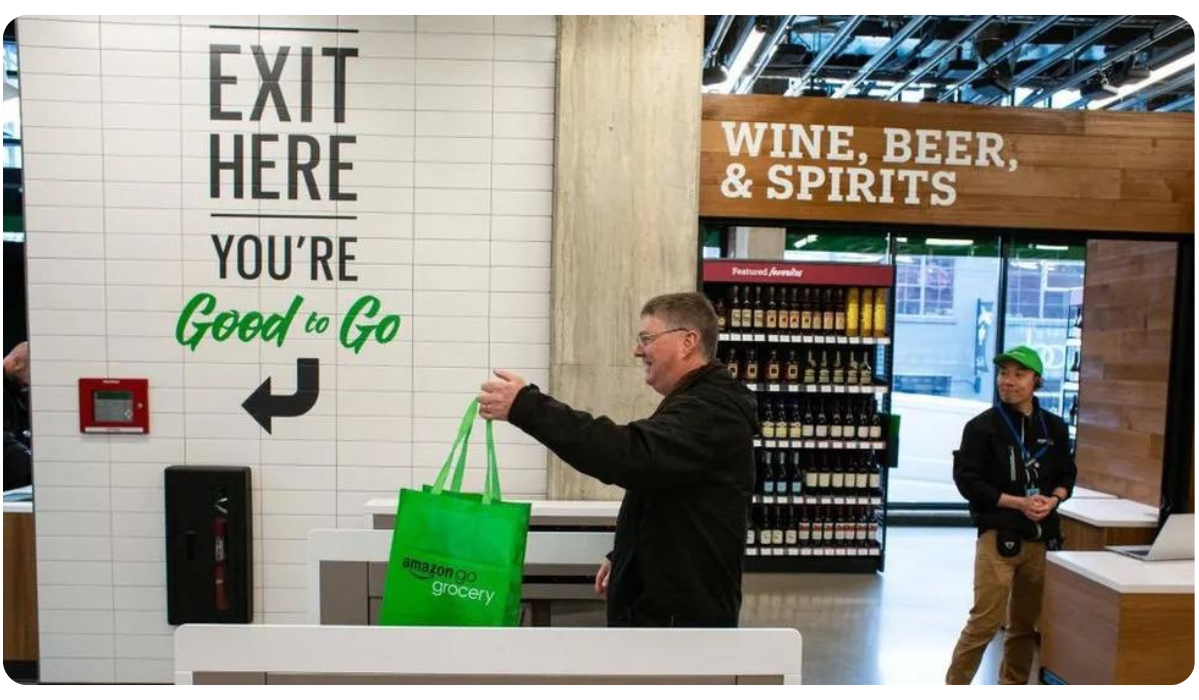
However, recent revelations show that Amazon's technology wasn't entirely automated. Despite being deployed in half of Amazon Fresh stores, the system relied heavily on a team of over 1,000 remote cashiers in India.
“There’s a grey area in artificial intelligence filled with millions of humans who work in secret — they’re often hired to train algorithms but end up operating much of their work instead.” – Parmy Olson for Bloomberg.
Reports from Business Insider & The Information indicate that the technology faced significant challenges, proving slow and costly to implement. 700 of every 1,000 walkouts had to be reviewed, meaning the remote cashiers took hours to process data, delaying customer receipt generation.
Critics have also raised ethical concerns about Amazon's practices. Not only did Amazon underpay their third-party workers instead of hiring locally, but the company's accumulation of sensitive customer data, including in-store behaviour, has sparked privacy debates, turning routine shopping trips into potential breaches.
As Computer Vision technology has become a formidable force in the CPG industry, this breaking story has forced CPG brands to consider what real computer vision technology looks like and if it is viable for their business needs.
How Neurolabs Does CV Differently
In light of recent revelations about Amazon's 'Just Walk Out' technology, it's evident that the promises of seamless retail experiences through AI and computer vision are not always fulfilled.
As the retail landscape evolves, Neurolabs remains committed to providing technical solutions that empower businesses while upholding the highest standards of integrity and performance.
Our technology leverages synthetic data, generating 3D models for training and surpassing the limitations of real data. This approach ensures enhanced reliability, accuracy, speed, and cost efficiency in data processing and analysis.
“In the past, we relied on a 60-person team of annotators and couldn’t achieve the desired accuracy results. Now, we use Neurolabs for Image Recognition.”— Tier 1 Soft Drinks Manufacturer.

Our state-of-the-art Image Recognition technology ‘ZIA’ (Zero Image Annotations) is designed by experts to offer features such as:
- Zero Human Annotations: Synthetic Computer Vision offers multi-modal metadata at minimal expense. Unlike traditional Computer Vision, SCV generates training data programmatically. Its robustness stems from eliminating human annotation errors inherent in conventional CV methods.
- Rapid Product Onboarding: With our ZIA Capture app, onboarding new products takes less than 30 seconds per SKU, enabling swift catalogue updates and achieving over 96% accuracy right from the start.
- Advanced Training Models: Our training models continuously enhance accuracy over time, leveraging an extensive dataset of over 2 billion product images and 72 million shelf images. This robust capability ensures your catalogue remains consistently updated and offers deeper insights, saving valuable time and resources.
- Seamless Integrations: ZIA effortlessly integrates with your current infrastructure, including Sales Force Automation solutions, ensuring seamless compatibility across various regions and remaining flexible to industry demands.
- Enhanced Visibility through ISSU: ZIA's In-Store Scene Understanding extends beyond shelf-level insights, delivering a comprehensive view of the entire in-store environment, including competitor strategies and consumer interactions. Thus, it enhances overall visibility and strategic decision-making.
-
While Amazon's approach faced challenges and ethical concerns, Neurolabs stands apart with our innovative ZIA technology. Unlike Amazon's reliance on third-party workers and questionable data practices, ZIA offers a superior solution that is efficient, reliable, and ethical.
With seamless integrations, rapid product onboarding, advanced training models, and enhanced visibility through In-Store Scene Understanding (ISSU), Neurolabs ensures that businesses have access to cutting-edge computer vision technology that is both effective and efficient.
Book A Demo Today
In the rapidly evolving retail technology landscape, the recent news about Amazon's technology underscores the importance of integrity and efficiency in adopting new solutions.
Using synthetic computer vision, we have created a solution that eliminates human error and offers users superior accuracy, speed, scalability, and reliability.
Experience the transformative power of ZIA firsthand by booking a demo today and revolutionising your business's approach to retail execution.
At Neurolabs, we are revolutionising in-store retail performance with our advanced image recognition technology, ZIA. Our cutting-edge technology enables retailers, field marketing agencies and CPG brands to optimise store execution, enhance the customer experience, and boost revenue as we build the most comprehensive 3D asset library for product recognition in the CPG industry.

Related Resource



%20(1).png)
.svg)
Get the latest Execution Intelligence news and resources direct to your inbox
Industry insights, retail intelligence and field-tested execution playbooks, so you always know what's happening in store.
.png)

.svg)

© 2026 Neurolabs. All rights reserved

