.svg)

Trade Promotion Compliance: Where Your Trade Spend Quietly Leaks

July 29, 2026
Trade promotions are the second-largest line on most CPG profit and loss statements, with 25% to 30% of gross sales tied up in trade investment. A large share of that money is spent on trust. A promotion is agreed with the retailer, funded and booked as executed. Whether the display actually went up, in the right stores, on the right dates, at the agreed price, is rarely checked while it still matters.
Closing that gap is the whole job of trade promotion compliance. Yet the way most brands run it, the budget has already gone by the time anyone confirms what happened.
Industry estimates put the share of trade promotion spend that goes unverified as high as 60%. For a brand spending nine figures on trade, that is not a rounding error. It is the largest pool of unmanaged trade spend most teams cannot see, which makes it one of the biggest recovery opportunities on the P&L.
What trade promotion compliance actually measures
Trade promotion compliance is the check between what you paid a retailer to do and what actually happens on the store floor. It asks a short list of blunt questions. Did the feature run? Did the display appear in the stores you funded? Was the promotional price live at the till? Did it all happen inside the agreed window?
This is a different discipline from planning the promotion or booking the spend. Your trade promotion management system knows what was agreed. Your finance team knows what was paid. Neither can tell you what happened on the floor. That last mile, the physical reality in store, is where trade promotion execution succeeds or fails. It is also the part almost nobody verifies at scale.
.webp)
Why the usual compliance check arrives too late
Most promotion compliance today runs on field visits and retailer scorecards. A rep visits a fraction of stores, notes what they see and the data trickles back over the following weeks. By the time it lands, the promotion is over and you are reading a report about money you can no longer recover.
Field visits are not the only fallback. When a rep cannot get to the store, most brands lean on syndicated data, Circana or NIQ, to work out whether a promotion landed. It is a useful read on the market but it answers a different question than compliance does. Syndicated data measures the outcome, not the execution: it tells you volume moved, not whether the display actually went up. It is a modelled sample rather than your estate, so the specific outlets that never built the display are not surfaced in the moment, when it matters. This data also arrives weeks after the window has closed so it confirms the shortfall without ever preventing it. Compliance answers the question syndicated data cannot: did the display you funded go up, in the right stores, in time to fix it if it did not.
Timing is the whole game. A display that never went up in week one of a four-week feature is not a data point to file. It is a live problem you can still fix if you hear about it on the Tuesday rather than the following month. Years of delayed reporting have trained brands to accept the post-mortem. A promotion that ends before you learn it underperformed leaves you explaining the shortfall instead of preventing it.
Trade promotion compliance should mean a read fast enough to act on. We use the term near real time deliberately: quick enough to get the display fixed while the feature is still live.
.webp)
Where the promotional budget leaks
Promotions fail quietly. The loss rarely shows up as one dramatic miss. It shows up as four smaller gaps that repeat across an estate.
First, the display that never appeared. The stock shipped, the funding cleared and the unit sat in the back room or never got built. You paid for visibility you never received.
Second, the wrong stores or the wrong week. A feature runs, but in half the outlets it was meant to cover or a week later than agreed. The plan looks executed on paper. The volume tells a different story.
Third, the price that did not stick. The promotional mechanic was signed off, yet the shelf edge still shows the everyday price. Shoppers never saw the offer, so the lift never came.
Fourth, the promotion that started late or ended early. A weekend feature that goes live on Sunday afternoon loses its best trading hours before it begins.
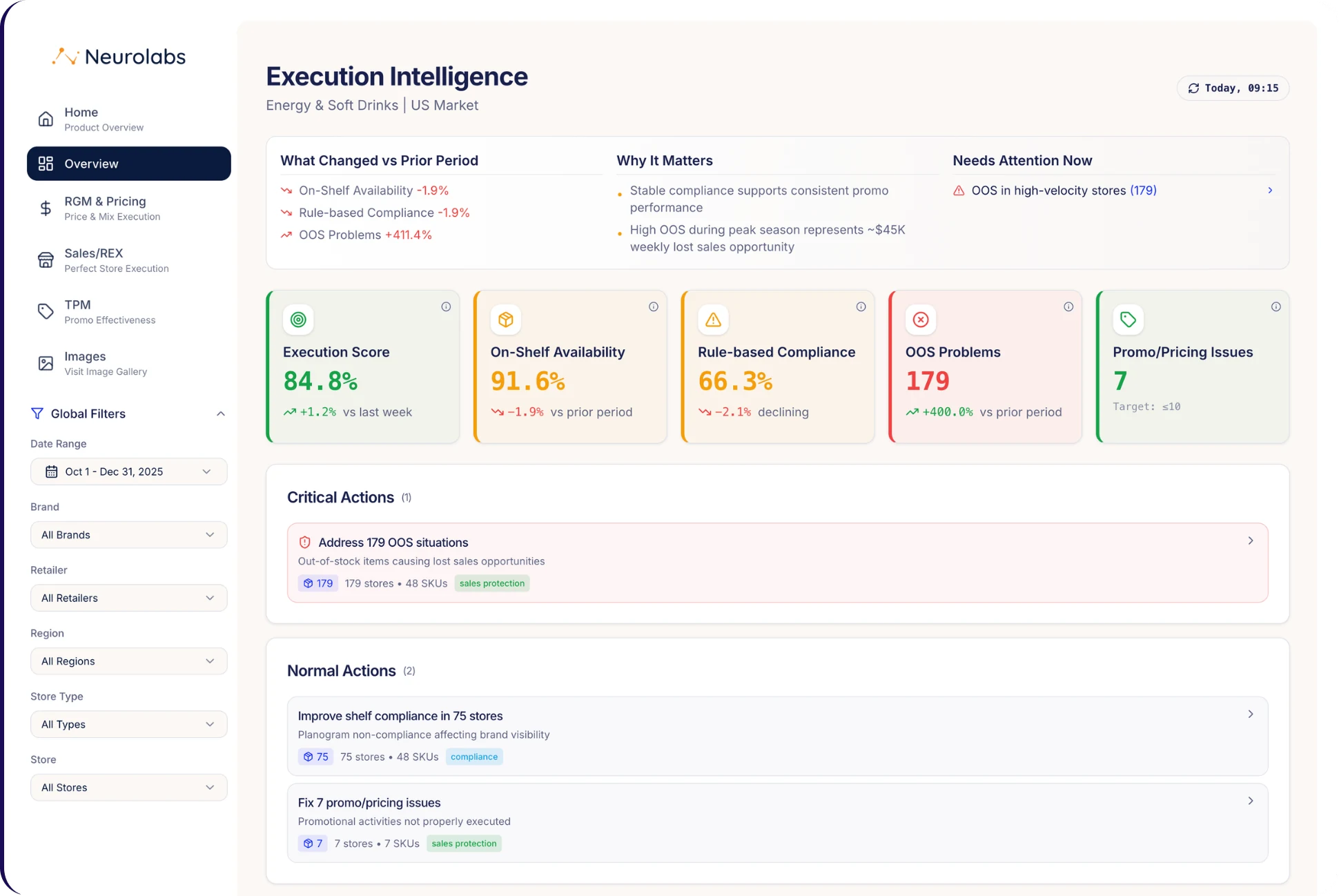
Each of these is small on its own. Across hundreds of stores and dozens of promotions a year, they compound on trade spend ROI. Display compliance alone, the simple question of whether the units you funded are standing where they should, routinely accounts for a large slice of the lost spend.
What good trade promotion compliance looks like
A better end-of-quarter report is not the answer. Strong compliance rests on three things.
Evidence, not assertion. Image-level proof of what was on the shelf, store by store, is something no retailer can talk their way around. It turns a compliance meeting from a debate about whose number is right into a decision based on what the shelf actually showed. Brands that walk in with proof recover deductions and hold partners accountable. Brands that walk in with an opinion negotiate.
Coverage, not a sample. A promotion runs across your whole funded estate, so your compliance view should too. The stores no one visited are exactly where execution slips unseen. This is where turning retail execution into measurable ROI starts: seeing every store, not a confident guess built from a few.
Speed, not hindsight. A gap flagged while the feature is live can still be closed. The same gap reported next month is just a number in a loss column. That shift, from measuring promotions after the fact to managing them while they run, is the point of Execution Intelligence: the layer between what your commercial team funded and what the shelf actually delivered, in time to act.
.webp)
The brands pulling ahead are not the ones with the most detailed promotion recaps. They are the ones who saw the display was missing while the feature was still live and fixed it. Given how much ROI leading brands unlock from point-of-sale displays, proving those displays executed is one of the cheapest ways to protect the volume you already paid for.
Want to see whether your promotions actually executed, store by store, while you can still act on it? Request a walkthrough and we will show you the trade spend your current reporting cannot account for. See how it works.
FAQ
What is trade promotion compliance?
Trade promotion compliance is the check between what a brand paid a retailer to run and what actually appeared in store: the display, the feature, the promotional price and the timing. Done well, it verifies execution across the funded estate in near real time, with image-level evidence, rather than reconstructing it from field visits weeks later.
How is trade promotion compliance different from trade promotion management?
Trade promotion management plans and books the promotion. It records what was agreed and what was paid. It cannot see the shelf. Compliance is the missing half: confirming the plan actually executed in store. One holds the intent, the other holds the reality.
How much trade spend is lost to poor promotion compliance?
Industry estimates suggest up to 60% of trade promotion spend goes unverified, so a meaningful share funds displays that never went up, prices that never went live and features that ran in the wrong stores. The exact figure varies by category, but the revenue loss is large enough to be a board-level number for most CPG brands.

Related Resource



.svg)
Get the latest Execution Intelligence news and resources direct to your inbox
Industry insights, retail intelligence and field-tested execution playbooks, so you always know what's happening in store.
.png)

.svg)

© 2026 Neurolabs. All rights reserved

