.svg)

40–60% of Trade Promotion Spend Goes Unverified. The World Cup Makes That Risk Bigger

June 8, 2026
Trade promotion spend is one of the largest investments most CPG brands make.
It’s designed to drive:
- Incremental sales
- Category growth
- Market share gains
And during major sporting events like the World Cup, that investment increases significantly.
- More promotions
- More displays
- More pricing activity
- More pressure to perform
For many categories, these moments represent a major opportunity to deliver outsized commercial returns but that opportunity depends on execution.
The Visibility Gap in Trade Promotion
From a commercial perspective, this will feel familiar. You already have strong visibility into how trade promotion spend is planned and measured.
You track:
- Promotion calendars
- Spend allocation
- Forecasted uplift
- Post-event performance
- Base vs incremental sales
On paper, everything is measurable but there is a critical gap.
Industry estimates suggest that 40–60% of trade promotion spend goes unverified at the point of execution.
That means you often can’t confirm:
- Whether a trade promotion was executed as planned
- Whether pricing was implemented correctly
- Whether displays were built and visible
- Whether products were available during peak demand
The result is that a significant portion of your trade promotion investment isn’t directly linked to what actually happened in store.
This broader challenge, the gap between planning and in-store execution, becomes even more critical during major retail moments and is something we explored in more detail in our article on why the World Cup is won in store.
Why the World Cup Makes This Risk Bigger
During normal trading conditions, this visibility gap is already a challenge but during the World Cup, it becomes amplified.
The scale and intensity of activity increases:
- More concurrent promotions
- Greater reliance on secondary displays
- Higher demand volatility
- Increased operational pressure in store
At the same time, the window to capture value becomes shorter.
Demand spikes are concentrated around key moments including match days, weekends, peak shopping periods. If execution breaks down during those windows, the impact is immediate.
- A promotion that isn’t visible
- A price that isn’t applied
- Stock that runs out too early
Each of these represents lost incremental sales but when multiplied across stores, categories and days, the financial impact becomes significant.
The Cost of Unverified Spend
When trade promotion spend is not verified in store, you are left interpreting outcomes without context.
A promotion underperforms… but why?
- Was demand lower than expected?
- Was the mechanic ineffective?
- Or did the promotion simply not execute as planned?
Without visibility, these questions are difficult to answer.
Which creates two main risks:
1. Misattribution
You may optimise future promotions based on incorrect assumptions, adjusting pricing or mechanics when the real issue was execution.
2. Lost Opportunity
The biggest issue isn’t just what’s lost, it’s what could have been gained.
Because when trade promotion is executed correctly, especially during high-demand events, it can deliver significant incremental volume and category uplift.
This is where the opportunity sits. Not just in increasing spend but in ensuring that spend translates into execution.
From Spend to Execution
Traditionally, trade promotion performance has been evaluated after the event.
Through:
- Sales data
- Syndicated data (often 4–6 weeks later)
- Post-event analysis
This creates a lag between:
Investment → Execution → Insight → Action
By the time insights are available, the opportunity has passed.
This gap between planning and in-store reality becomes even more visible during major events, something we explored in more detail in From Plan to Reality: Why Major Sporting Events Expose the Execution Gap.
But a shift is underway.
Leading organisations are moving toward connecting trade promotion spend directly to in-store execution.
This means:
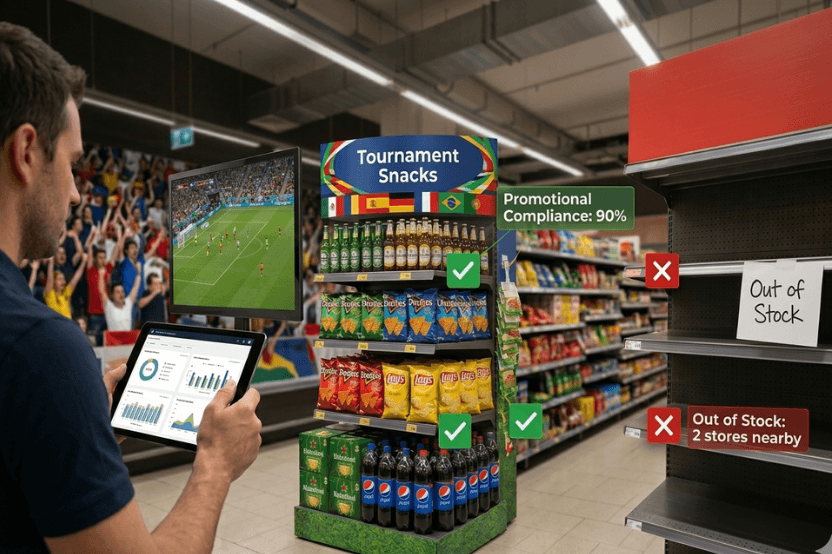
- Verifying promotional compliance at the store level
- Monitoring on-shelf availability, pricing, competitors and promotions during peak demand
- Identifying where execution is breaking down
- Acting while campaigns are still live
Turning Trade Spend Into Measurable Impact
When you can see what is happening in store, trade promotion spend becomes:
- Visible — linked to real execution, not just plans
- Measurable — tied to what actually happened in store
- Actionable — enabling you to intervene in real time
Instead of relying solely on post-event analysis, you can:
- Protect trade promotion investment
- Capture incremental sales as demand unfolds
- Prioritise the stores and issues that matter most
During major events like the World Cup, this shift is critical because success rarely comes down to the plan itself, but whether it actually executed in store.
From Risk to Opportunity
The fact that 40–60% of trade promotion spend goes unverified highlights a significant challenge but it also highlights a significant opportunity.
For brands that can close the gap between spend and execution, the upside is substantial:
- Greater return on trade investment
- Improved promotional effectiveness
- Stronger category performance
- Increased confidence in decision-making
The World Cup doesn’t just increase the risk of wasted spend, it increases the value of getting execution right.
Turn Trade Promotion Spend Into Measurable Performance
Trade promotion is one of the largest levers for driving growth but only when it executes as planned.
Execution Intelligence provides a granular view of what is happening across stores, enabling teams to verify promotions, monitor availability and act while campaigns are still live.
Learn more about Execution Intelligence
Or if you'd like to explore how this applies to your organisation:

Related Resource


.svg)
Get the latest Execution Intelligence news and resources direct to your inbox
Industry insights, retail intelligence and field-tested execution playbooks, so you always know what's happening in store.
.png)

.svg)

© 2026 Neurolabs. All rights reserved

