.svg)

Retail Merchandising Software Plans the Shelf. It Can't Prove It.

October 12, 2026
A shelf that doesn't match the plan is lost volume. For a brand with national distribution, a single week of weak execution can cost seven figures. Retail merchandising software was meant to prevent that. It builds the planogram, schedules the visit and routes the rep. What it rarely does is prove that any of it reached the store.
Planning is not the same as proof. One tells you what should be on the shelf and the other tells you what is. Commercial teams carrying a number need the second but too often they get the first.
The category sells planning, not proof
Ask what your retail merchandising software does and you will hear a familiar list: It builds planograms, it sets cycle plans, it gives reps a checklist for each store, it logs what they entered when they left, it may even ask for a photo of the shelf as proof. All useful but none of it confirms what a shopper actually saw.
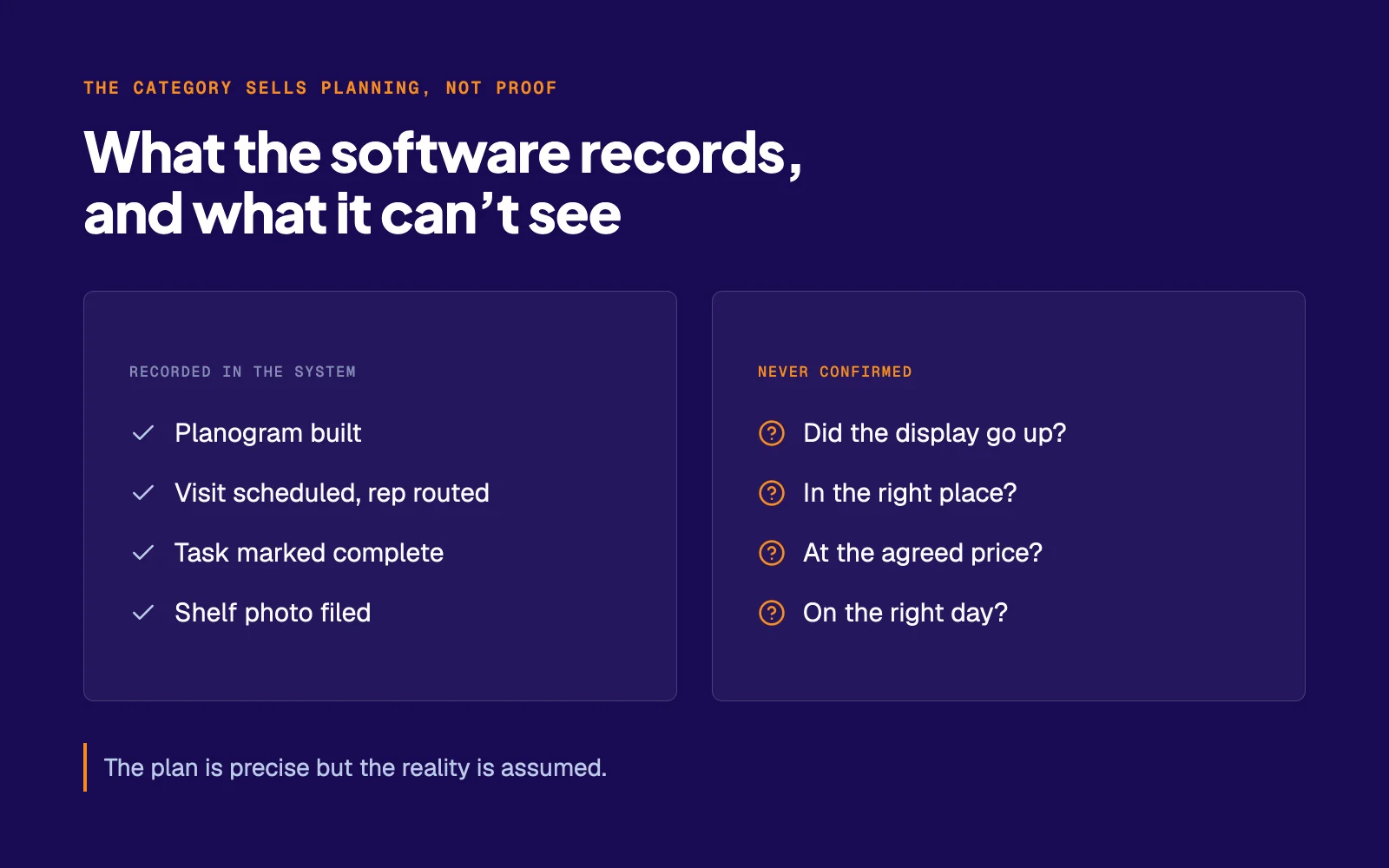
The data the system holds is mostly self-reported. A rep marks a task complete and a store is scored against a template. The record says the display went up. Whether it truly did, in the right place, at the agreed price, on the right day, sits outside the software's view. The plan is precise but the reality is assumed.
Photos don't close that gap on their own. Many teams ask reps to snap the shelf before they leave, and those images land in a folder that no one checks, or checks once a quarter. Nothing is read from them, so nothing is acted on. Worse, they create a false sense of security: the business believes it has proof of execution when all it has is an archive.
That assumption is expensive. Trade promotions are the second-largest line on most CPG profit and loss statements. When merchandising software records the intent but never verifies the outcome, the biggest pool of spend on the P&L runs on trust. This is the quiet flaw in how the future of merchandising is still being sold: better planning tools, no better proof.
Where retail merchandising software goes quiet
The gap shows up in three places every commercial leader will recognise.
Coverage. A rep visits a slice of the estate on a cycle. The stores no one reached this week stay invisible until the numbers come in light and by then the cause is guesswork.
Latency. Self-reported completion lands in the system on the rep's schedule, not the shelf's. A task marked done on Thursday tells you nothing about the empty facing on Friday.
Proof. A ticked checklist is a claim, not evidence, and a folder of unread rep photos isn't much better. When a retailer disputes a deduction or a display charge, a completed task in your merchandising software settles nothing. Image-level proof that has actually been read does because brands that walk into that meeting with evidence recover money and brands that walk in with an opinion negotiate.
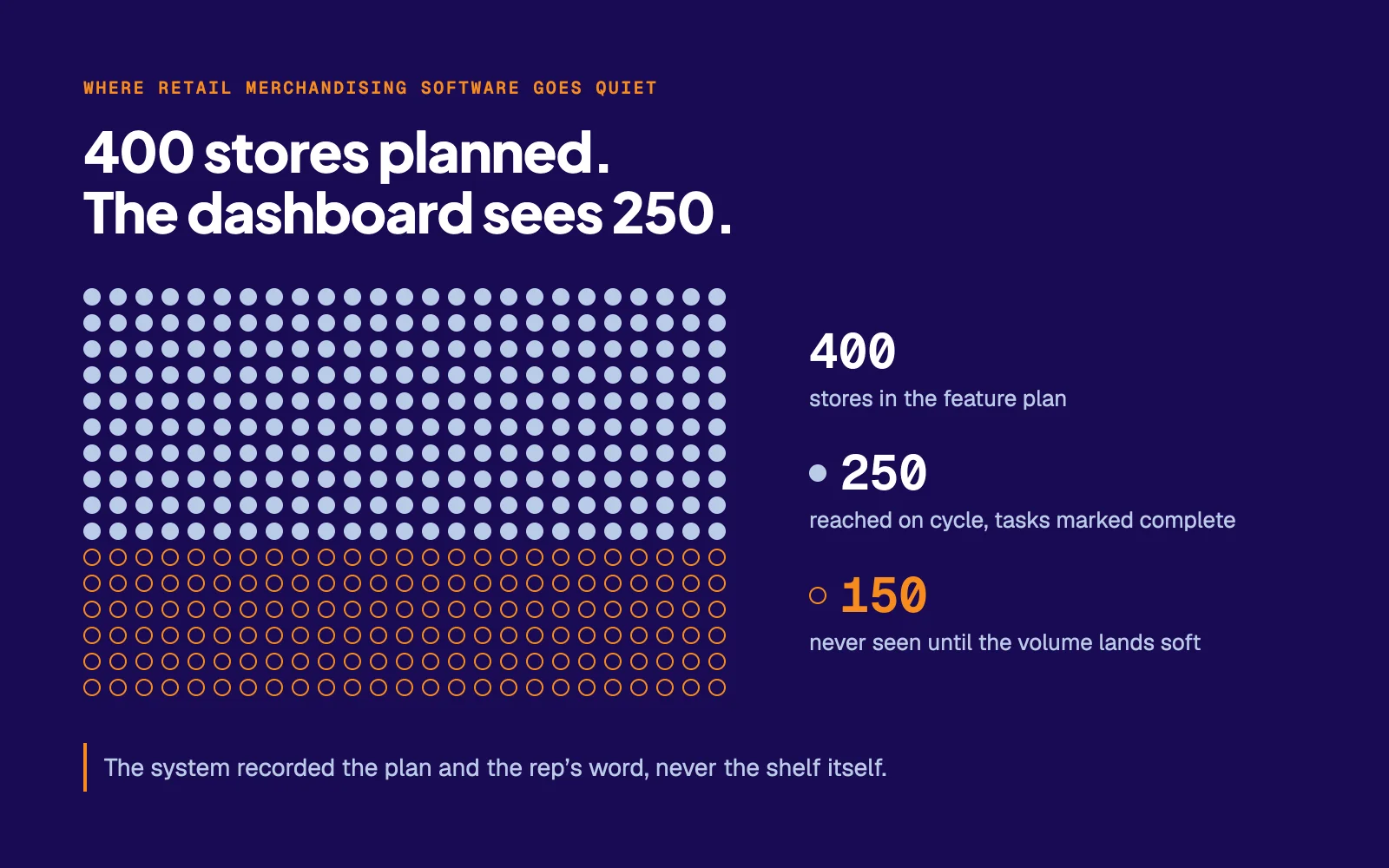
Put the three together and the pattern is familiar. A feature is planned across 400 stores. Reps reach 250 of them on cycle. Tasks get marked complete. The dashboard shows healthy compliance. Then the volume lands soft and no one can say which stores let you down, because the system recorded the plan and the rep's word, never the shelf itself. The read that would have let you act arrived as a post-mortem and unfortunately, the category has trained commercial teams to accept exactly that.
What to demand from retail merchandising software
The fix is not more planning. It’s verification of the plan you already built. The question to put to any retail merchandising software is blunt: can it prove what was on the shelf, in the stores that carry your number, while there is still time to act?
That single test reorders the priorities. Observed reality beats a completed checkbox. Coverage you choose beats coverage you settle for. A flag that reaches the person who can fix the shelf today beats a report someone reviews next quarter.
In practice, merchandising software earns its keep when it does three things. It captures what is actually on the shelf: availability, price, promotion and placement, as observed fact rather than a rep's note. It delivers that read in near real time, fast enough to act inside the same selling window. And it hands the team evidence, not opinion, so the argument about whose number is right ends at the image.
The same evidence changes how you reward the field. Where reps or store partners are incentivised on execution, through bonus schemes or loyalty programmes, payouts are only as fair as the score behind them. Image recognition applies one objective standard to every visit, so rewards follow what the shelf shows rather than what was reported, and the people doing the work well can see it counted.
This is the shift from scheduling execution to managing it. It’s also where turning retail execution into measurable ROI starts: seeing the stores that matter, not a confident guess built from whichever few the route reached.
It completes your stack. It doesn't replace it.
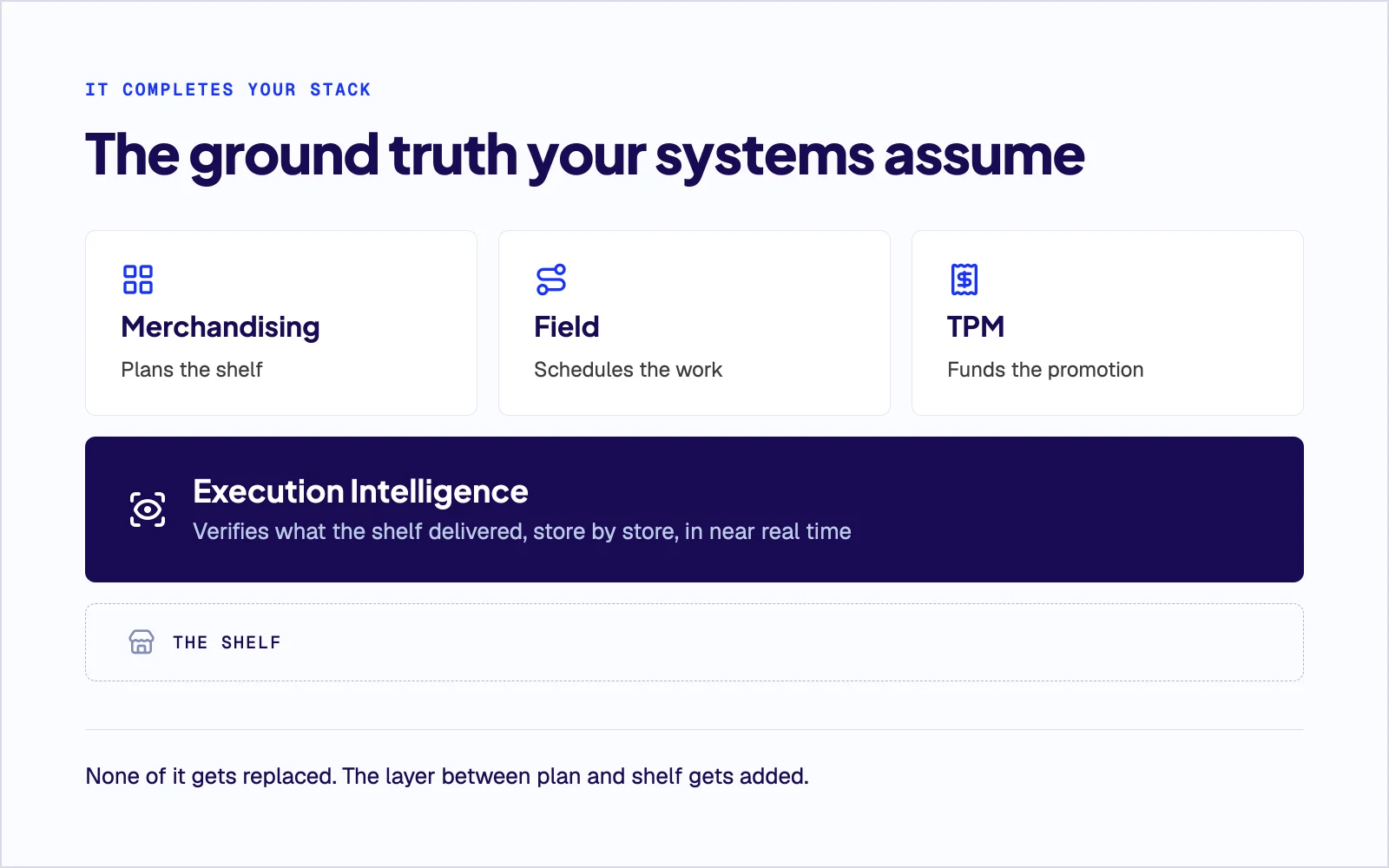
None of this means ripping out the tools you run. Your merchandising, field and TPM systems assume the shelf reflects the plan but they were never built to verify it. Execution Intelligence supplies the ground truth they are missing: the layer between what your team scheduled and what the shelf actually delivered, in time to change the outcome. See how it works.
The brands pulling ahead are not the ones with the tidiest cycle plans. They are the ones who saw the display was missing while the promotion was still live and fixed it. This is the difference between smarter audits and audits that actually drive execution. Retail merchandising software that only records what a rep entered is documenting intent. The point is to prove execution, while it still matters.
Want to see what your shelves actually look like, store by store, while you can still act on it? Request a walkthrough and we will show you the gaps your merchandising reporting cannot.
FAQ
What is retail merchandising software?
Retail merchandising software helps brands and field teams plan and manage in-store activity: planograms, cycle plans, store visits and task lists for reps. It records what was scheduled and what a rep reported. On its own it does not verify what actually appeared on the shelf, which is why strong plans can still coincide with soft volume.
Can retail merchandising software prove a promotion executed?
Not by itself. Most systems log a rep's completed task, not observed shelf reality. Proof needs image-level evidence of availability, price and placement across the funded estate, captured fast enough to fix a gap while the promotion is still live.
Does Execution Intelligence replace merchandising software?
No, it completes it. Your merchandising and field systems plan and schedule the work. Execution Intelligence verifies the result, store by store, in near real time, so weak in-store execution stops hiding behind a completed checklist.

Related Resource


.svg)
Get the latest Execution Intelligence news and resources direct to your inbox
Industry insights, retail intelligence and field-tested execution playbooks, so you always know what's happening in store.
.png)

.svg)

© 2026 Neurolabs. All rights reserved

