.svg)

Retail Intelligence That Arrives Too Late Isn't Intelligence
August 21, 2026
A display that never goes up, or a shelf that sits empty, on the busiest day of a promotion is lost volume you never get back. For a brand with national distribution, one soft execution week can cost up to seven figures. The arithmetic is not dramatic, it's just unforgiving. Take a feature running in 4,000 stores on a line that turns an extra £1,000 to £1,500 in a promotion week. If the display goes up late, goes up wrong, or never goes up at all in one store in five, then 800 stores traded at their base rate through the biggest week of the plan. That is a seven-figure week, before you count what it does to the retailer's view of whether you can be relied on.
Retail intelligence was supposed to warn you before that happened but most of it does the opposite. It confirms the miss weeks later, once the money has already walked out of the store.
Here is the uncomfortable truth. The category has trained commercial teams to call a rear-view mirror "intelligence". Reports arrive, dashboards fill up, none of it changes the outcome and that’s because all of it describes a window that has already closed.
Most retail intelligence is a rear-view mirror
Ask what your retail intelligence gives you and the answer is usually a stack of reports or an abundance of syndicated sales data, panel estimates and a field team's audit from the stores they managed to reach. Each source is real but the problem, each one is late.
Syndicated data tells you volume dipped but it cannot tell you the display never went up in 90 stores. By the time the read lands, the promotion is over and you are left explaining a number rather than fixing one.
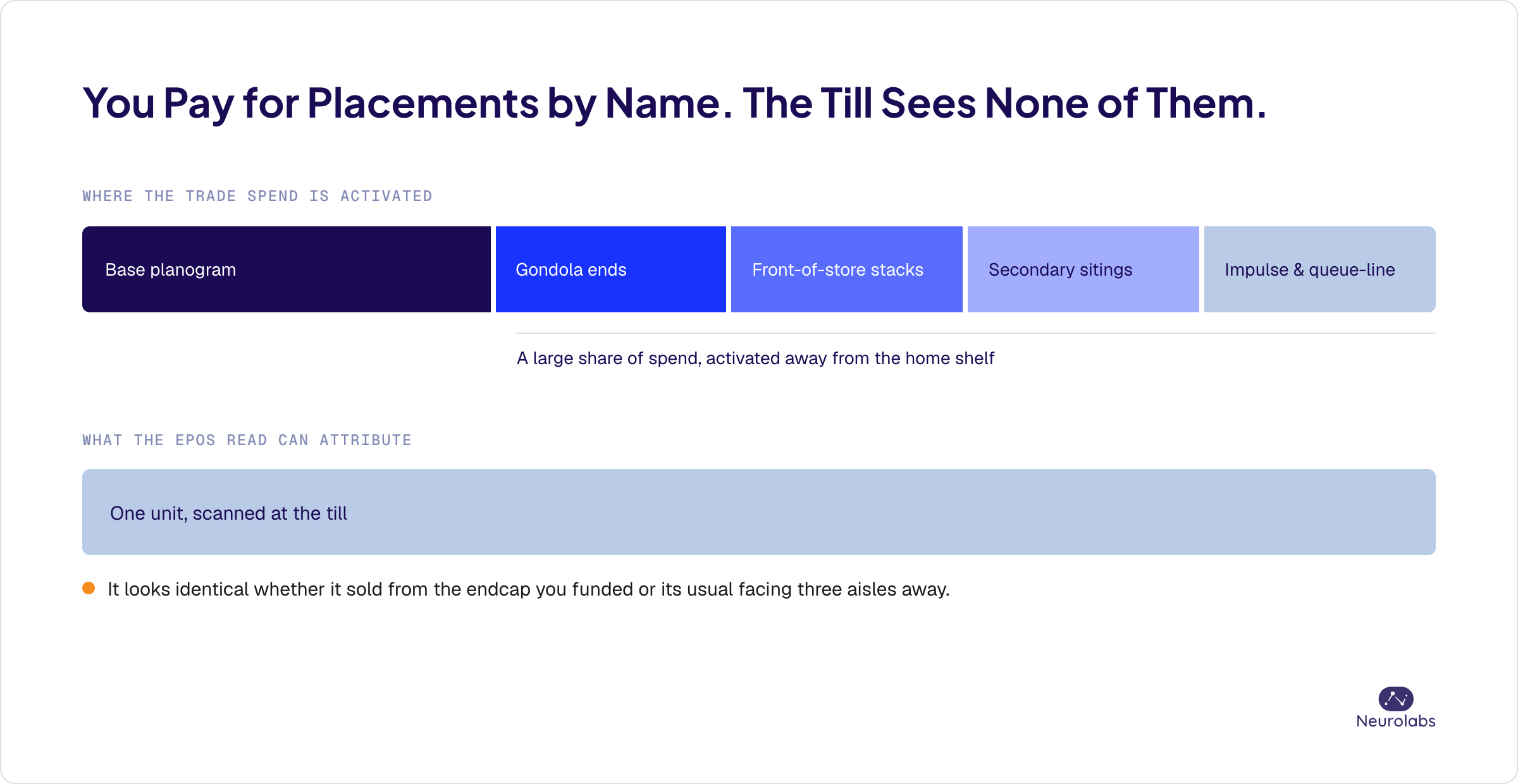
And the further you get from the base planogram, the darker it gets. A large share of trade spend is activated away from the home shelf: gondola ends, front-of-store stacks, secondary sitings, impulse and queue-line fixtures. Those are the placements you pay for by name and they are the ones syndicated and EPOS reads are least equipped to see. A unit scanning at the till looks identical whether it sold from the endcap you funded or from its usual facing three aisles away. The spend is specific, the read is not.
This is the quiet flaw. The word "intelligence" implies you can act on it but post-mortems do not let you act, they let you apologise in the quarterly review.
Where the numbers go quiet
The gap shows up in three places every commercial leader will recognise.
Coverage. Traditional retail intelligence samples. A panel covers some stores, a rep visits a slice of the estate on a cycle, the stores no one measured stay invisible until volume comes in light, so the cause is left to guesswork.
Latency. A monthly report is a history lesson. It tells you what the shelf looked like weeks ago. The empty facing on Friday of a promotion week does not wait for the next data drop.
Proof. An aggregate number is not evidence. When a retailer disputes a deduction or a display charge, a line on a chart settles nothing. Image-level proof of what was on the shelf does. Brands that walk into that meeting with evidence recover money and brands that walk in with an estimate negotiate.
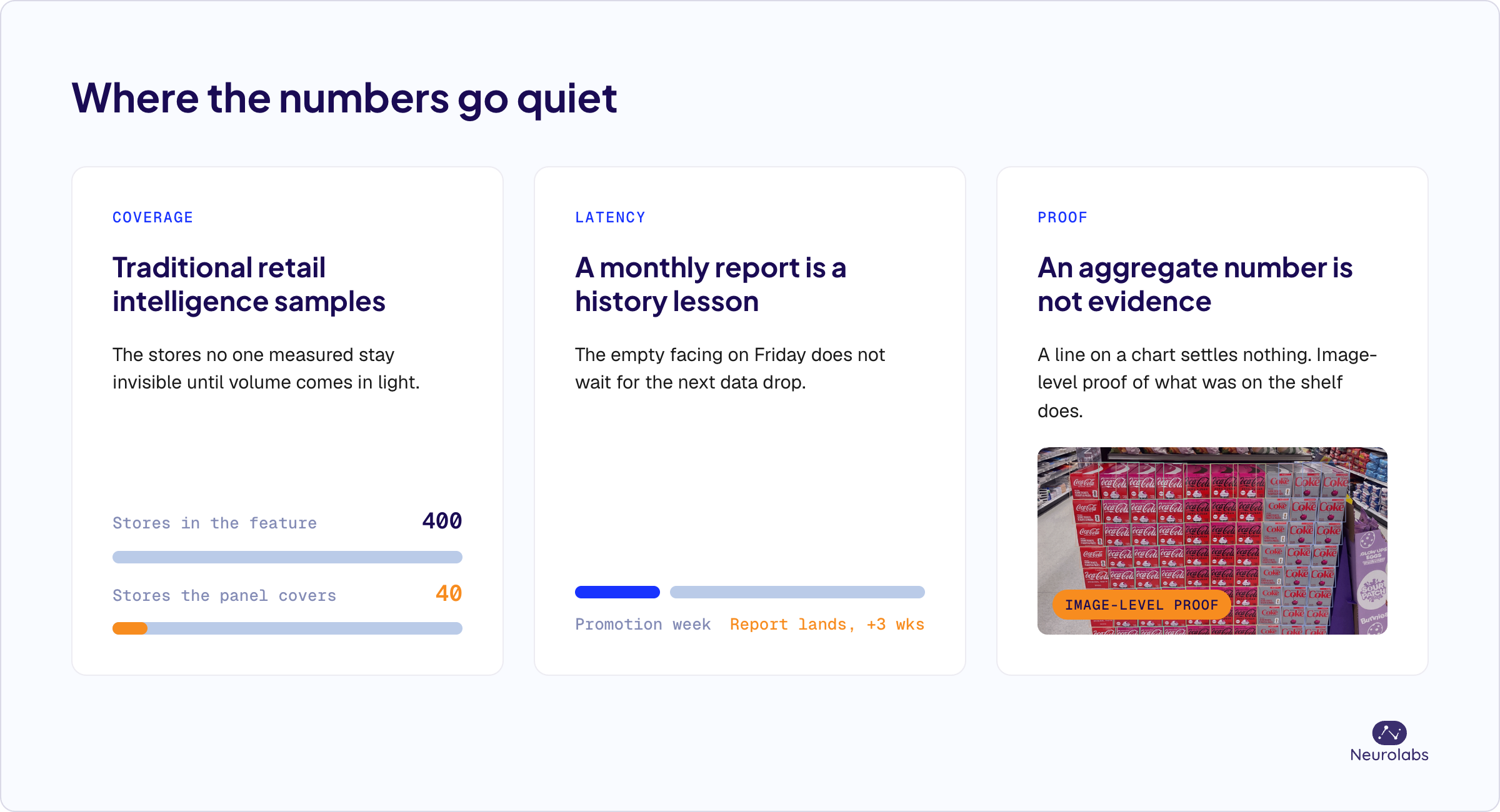
Put the three together and the pattern repeats. A feature ships to 400 stores, the panel covers 40. The report lands three weeks later and no one can say which stores let you down so the loss gets written off as "execution". The read that would have let you act arrived as a post-mortem. In many cases this is the process and it’s been accepted but the category is changing and it’s time to challenge the status quo.
What retail intelligence should actually tell you
Real intelligence answers one question while you can still do something about it: is the shelf right, in every store that matters, today?
Read "shelf" broadly here because your trade plan does. It means the base planogram in compliance, yes, but also the display built and sited where the plan said it would be, the gondola end you paid for, the price and mechanic showing correctly on the ticket, the impulse fixture by the tills not standing empty. Those placements carry a large share of the spend and almost none of the visibility.
In practice, retail intelligence earns its name when it does four things. It captures what is actually in the store: availability, price, promotion, planogram and display execution, as observed fact rather than an estimate. It delivers that read in near real time, with next best actions that are fast enough to act inside the selling window. It hands the team image-level evidence so the argument about whose number is right ends at the photo. And it converts that read into a next best action: not a list of everything wrong across 4,000 stores but the specific fix worth someone's time, ranked by the volume it protects and routed to the person who can make it. This is what execution visibility really looks like. Most brands do not have it yet.
Notice what changes when the read is fast enough to matter. Retail intelligence stops being a scorecard your team defends and becomes a tool your team uses. A missed facing is no longer a line in next month's review, it's a fix the rep is handed while they are still standing in the aisle and can take action. The value is not the data, it's the time you gain to act on it.
From reporting the shelf to acting on it
The shift is from measuring execution to managing it. Retail intelligence that only reports the past keeps you accountable for outcomes you had no chance to influence. Retail intelligence that reads the shelf now lets you protect the number while the promotion is still live.
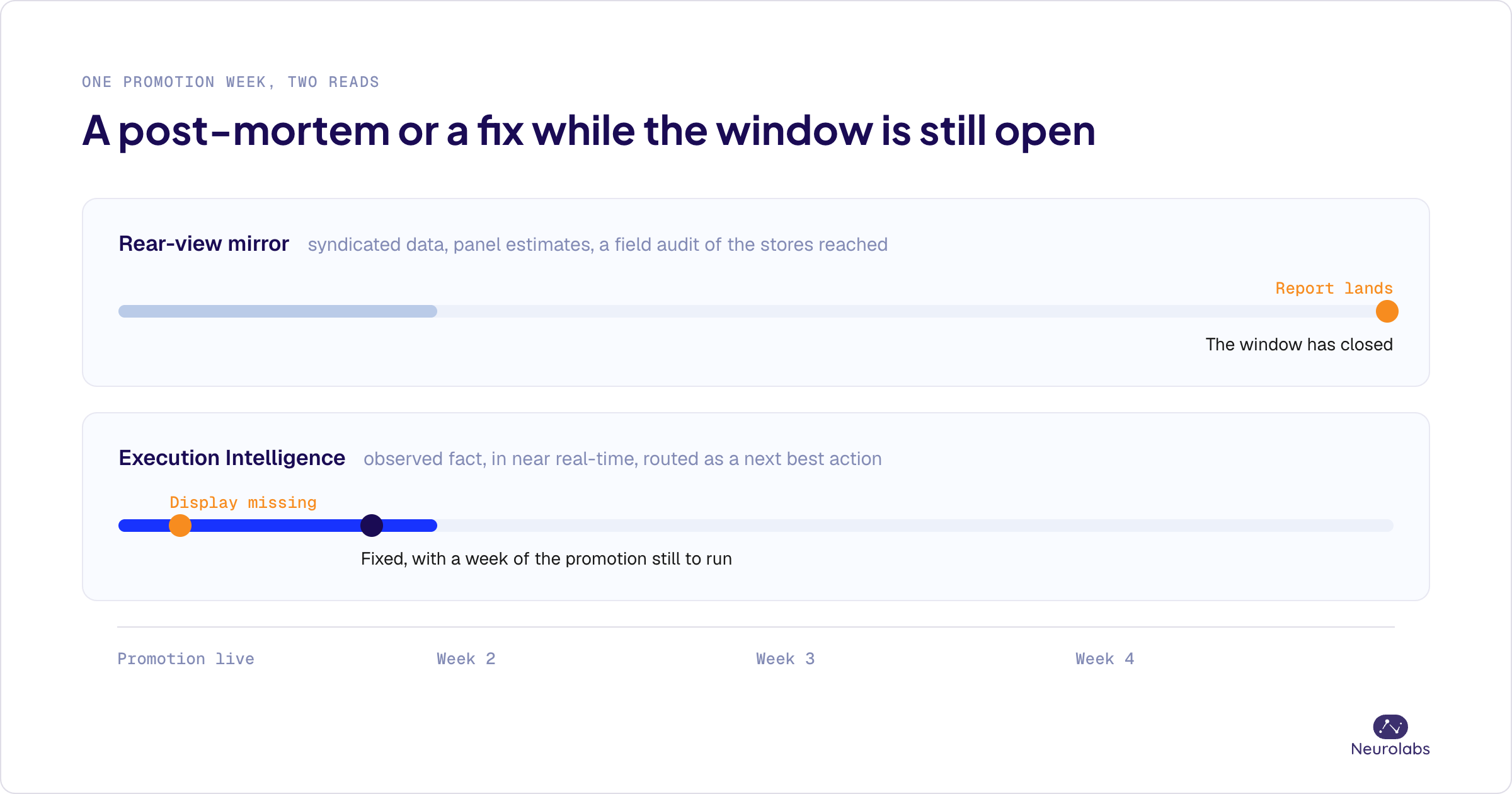
None of this means tearing out the tools you run. POS data, panel data and your TPM system all assume the shelf reflects the plan but they were never built to verify it. Execution Intelligence supplies the ground truth they are missing: the layer between what your team planned and what the shelf actually delivered, in time to change the result. See how it works.
The brands pulling ahead are not the ones with the thickest reports, they're the ones who saw the display was missing while the promotion still had a week to run, then fixed it. That is the difference between a smarter audit and an audit that actually drives execution. It's also where turning retail execution into measurable ROI begins: coverage you choose across the stores that carry your number, not a confident guess built from a handful.
Want to see what your shelves actually look like, store by store, while you can still act on it? Request a walkthrough and we will show you the gaps your reporting cannot.
FAQ
What is retail intelligence?
Retail intelligence is the data brands use to understand what is happening in stores: sales, availability, pricing, promotion, planogram compliance and display execution. Traditional sources such as syndicated data and panels describe what already happened. Execution Intelligence adds the missing piece: observed execution across the stores that carry your volume, captured fast enough to act on.
Why is most retail intelligence too late to be useful?
Because it's sampled then reported on a delay. By the time a monthly panel or syndicated read arrives the promotion window has closed. You can explain the lost volume but you cannot recover it. Near real time shelf data is what changes that.
How is Execution Intelligence different from retail analytics?
Retail analytics tells you what happened. Execution Intelligence tells you what is happening in the store right now with image-level proof and a ranked next best action, so commercial teams can fix a gap while the selling window is still open.
Does retail intelligence only cover the main shelf?
It shouldn’t. Displays, gondola ends, secondary sitings and impulse fixtures are where a large share of trade spend is activated and they are the placements syndicated and EPOS data are least equipped to see because a unit scanning at the till looks the same wherever it sold from. Execution Intelligence captures those placements as observed fact alongside the base planogram which is usually where the biggest unexplained gaps turn out to be.

Related Resource


%20(1).png)

.svg)
Get the latest Execution Intelligence news and resources direct to your inbox
Industry insights, retail intelligence and field-tested execution playbooks, so you always know what's happening in store.
.png)

.svg)

© 2026 Neurolabs. All rights reserved

