.svg)

Retail Execution's Next Chapter: From Visibility to Action

June 9, 2026
This isn't a typical blog post. It's what happens when the two of us, a CTO and a commercial leader, compare notes after months of customer meetings and realize we keep reaching the same conclusion from opposite ends of the business.
We come at this from very different angles. Over the last year, Patric has spent his time with technology leaders, enterprise architects and data teams, trying to make sense of increasingly complex information environments. Remus has spent his with commercial leaders, field organizations, retail operators and the people ultimately responsible for execution in the market. On paper, those should be very different conversations. In reality, they converge on the same observation.
The same conversation keeps coming up
A few months ago, after a series of customer meetings, we found ourselves comparing notes over coffee. The meetings themselves had little in common. Some focused on AI and enterprise infrastructure. Others revolved around promotions, pricing, retail execution and field performance. Some were highly technical; others deeply commercial. Yet as we talked through what we had heard, a common thread kept appearing.
Almost nobody was talking about a lack of data anymore.
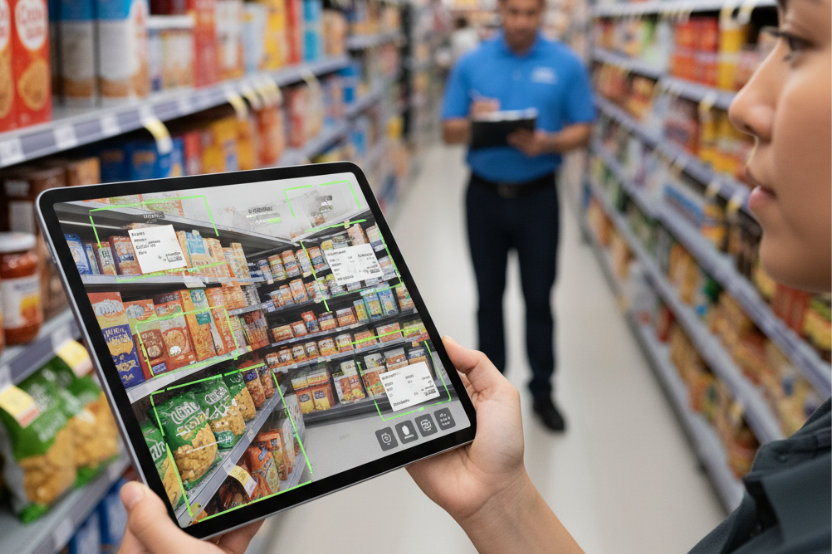
That caught us slightly off guard, because for a long time data was the problem. The industry spent years trying to create visibility where it simply didn't exist. Organizations wanted to know whether products were available, whether promotions had executed correctly, whether displays were built as planned and whether the reality in stores matched the expectations being set at headquarters. Entire categories of technology emerged to answer those questions and in many ways they succeeded.
Nobody's short of data anymore
Today we operate in a very different environment. Between retailer feeds, syndicated sources, field execution platforms, image recognition technologies and increasingly sophisticated enterprise data ecosystems, most large organizations already possess an extraordinary amount of information. In many cases, they have more visibility than they can realistically act upon.
And yet the same frustration surfaces again and again. Not frustration about what organizations know. Frustration about what they do with what they know.
One commercial leader described it perfectly. Walking us through a reporting environment packed with dashboards, execution metrics, compliance data and performance indicators, he paused, smiled and said: "The funny thing is, visibility isn't really our issue anymore. We can see almost everything. The challenge is figuring out how to respond before the moment has passed."
That comment stayed with both of us because we've been hearing it with increasing frequency.
Visibility was only the first chapter
For years, visibility was treated as the finish line. If an organization could identify an issue, measure it and report it, the assumption was that the problem had effectively been solved. Increasingly, visibility looks like only the first chapter. The harder challenge begins after the issue has been identified, when organizations must decide what matters most, who should act, how quickly they should respond and whether that response can happen while the opportunity still exists.
Retail has never been static, but the pace of change feels faster than ever. Promotions launch imperfectly, inventory fluctuates unexpectedly, pricing drifts across locations and competitors capitalize on opportunities long before quarterly business reviews ever take place. A single missed execution week can cost a brand seven figures in lost volume. The challenge is no longer simply understanding what happened. It's understanding it quickly enough to influence what happens next.
Two angles, one bottleneck
Remus, from the commercial side: I see this whenever I spend time with commercial teams in the field. Execution rarely unfolds as neatly as planning documents suggest. Teams constantly balance competing priorities, adapt to changing conditions and make decisions under pressure. The gap between what was planned and what actually happens is often where the most important commercial opportunities exist.
Patric, from the data side: The same challenge appears to me through a different lens. As organizations become more capable of capturing, processing and analyzing information at scale, the bottleneck moves. It no longer sits at the point of collection. It sits between insight and action. The technology exists. The data exists. The visibility exists. The real question is how quickly those signals can move through an organization and influence decisions while execution is still unfolding.
This is the gap we built Execution Intelligence to close, connecting what was planned, what actually happened in store and what to do about it while there's still time to act. The next chapter of retail execution won't be defined by who collects the most information but by who can operationalize it most effectively.
The shelf is becoming a live commercial signal
That doesn't mean dashboards disappear, or that reporting stops mattering, or that visibility becomes less important. If anything, those capabilities become more valuable. But their value increasingly comes from what they enable rather than what they display.
The shelf itself is evolving from a reporting surface into something far more dynamic: a live commercial signal that can shape prioritization, guide field activity, inform pricing and influence broader commercial outcomes while there's still time to change them. The organizations that learn to operationalize those signals faster will gain an advantage that extends well beyond reporting. They'll make better decisions, respond more effectively to changing conditions and build stronger connections between strategy and execution.
What we're bringing to Databricks Data + AI Summit
These are the conversations we're most excited to have at Databricks Data + AI Summit 2026. Not AI for the sake of AI and not dashboards for the sake of reporting but how modern organizations connect data, decision-making and execution in ways that create real business outcomes.
Because after hundreds of conversations across retailers, CPG organizations, field teams, technology leaders and enterprise partners, one idea keeps surfacing no matter where the conversation begins.
Somewhere along the way, data stopped being the problem. The ability to operationalize it, to turn what you can see into what you do, while it still matters, became the opportunity.
Seeing everything but still acting too late? That's the gap Execution Intelligence closes. Request a walkthrough and we'll show you what acting in-window looks like, store by store.

Related Resource

%20(1).png)
.svg)
Get the latest Execution Intelligence news and resources direct to your inbox
Industry insights, retail intelligence and field-tested execution playbooks, so you always know what's happening in store.
.png)

.svg)

© 2026 Neurolabs. All rights reserved

