.svg)

Retail Audit: Why It Usually Tells You What You Already Lost
August 27, 2026
A retail audit is meant to protect revenue but by the time the numbers land, the shelf has moved on, the promotion has ended and the volume you were trying to defend has already gone. The audit becomes a record of a loss you can no longer recover. For a brand running hundreds of stores, that lag is not a reporting quirk, it’s money.
The problem is not effort because field teams work hard, retailers cooperate then the data does get collected. The problem is timing. A retail audit built on periodic store visits tells you what the shelf looked like on the day someone stood in front of it, weeks before the report reaches a commercial decision maker, so in reality, you are managing the estate through a rear-view mirror.
That timing problem applies to both of the things commercial teams call a retail audit.
What we mean by a retail audit
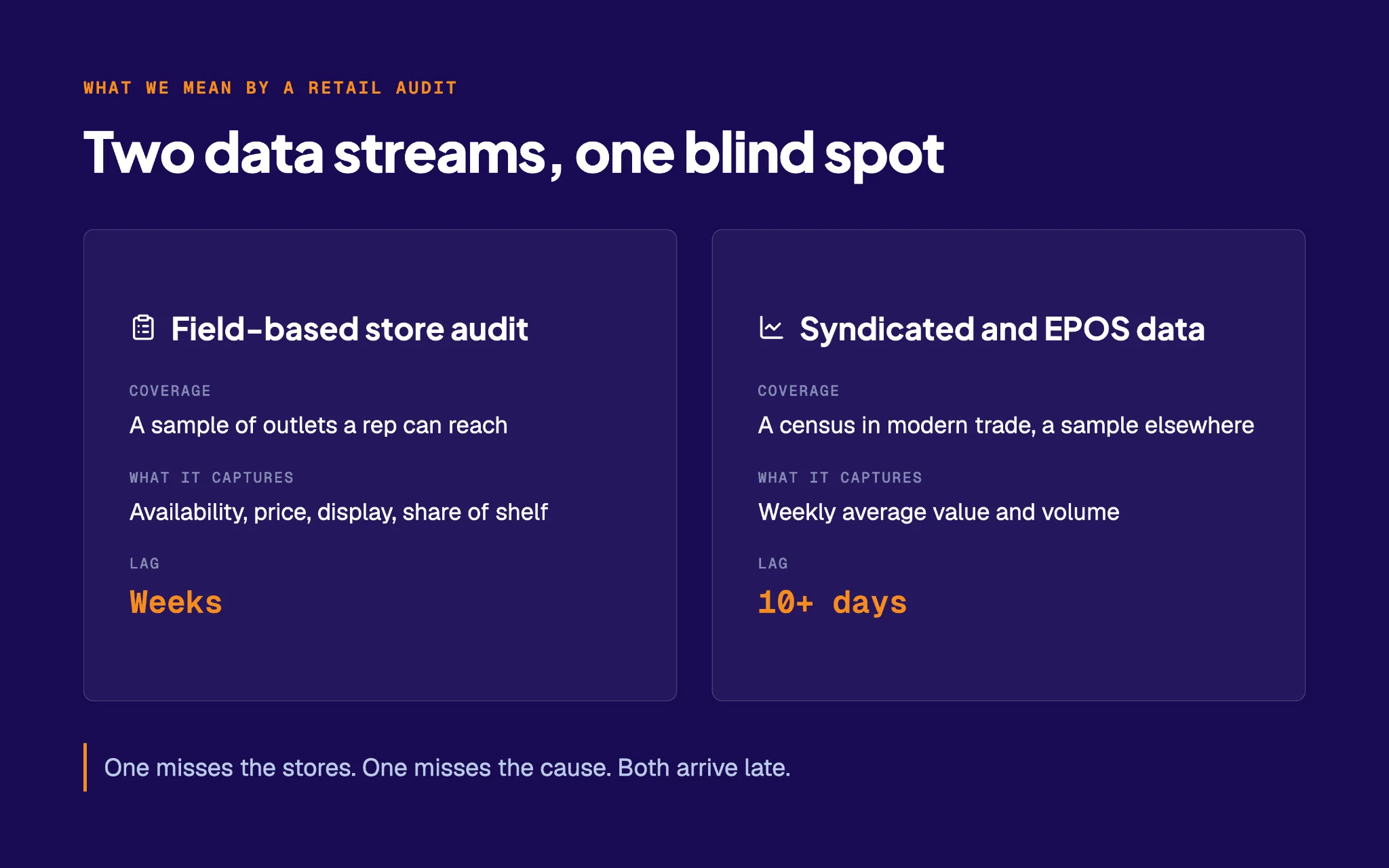
Two very different data streams get used to answer the same question: did our plan actually happen in store?
The first is the field-based store audit. A rep or a third-party auditor visits a sample of outlets, records availability, price, display and share of shelf, and the results are aggregated and reported over the following weeks.
The second is syndicated and EPOS data. Retailers share sales data with their suppliers, in some cases daily and commercial teams read stockouts and promotional performance out of the volume line.
Most CPG teams run both. Neither, on its own, tells you what is happening on your shelves in time to fix it.
What a retail audit is supposed to do
Strip it back and a retail audit answers a short list of commercial questions. Are our products actually on the shelf where we paid to be? Is the price at the shelf edge the price we agreed? Did the display go up, in the right stores, on the right dates? Is a competitor sitting in our space? Get honest answers fast and you can act: fix the gap, recover the deduction, protect your investments.
That is the whole value of a store audit, not the paperwork but the chance to do something about what it finds.
Why the field-based retail audit arrives too late
Most retail execution audits still run on the same model they did a decade ago. A rep visits a sample of stores, records what they see on a form or an app then the results are aggregated and reported over the following weeks. Three things break in that chain.
First, coverage. A rep can only visit so many stores, so the audit is a sample. The sample is not the problem in itself, because every serious measurement works that way. The problem is what shapes it. Most field samples are built around what the team can physically reach in a cycle rather than around the estate you are actually funding. A promotion paid for across 2,000 outlets gets read from the 200 someone had time to walk into, and the outlets no one reached are exactly where execution slips unseen.
Second, consistency. Two reps looking at the same shelf record it differently. What counts as compliant, what counts as out of stock, where a facing starts then stops: judgement varies store to store and the data arrives already noisy.
Third, the most costly break of all, speed. A shelf audit that reports a stockout a fortnight after it happened is not a warning, it’s a post-mortem. The sale is already lost. Years of delayed reporting have quietly trained commercial teams to accept this, to treat the audit as a scorecard rather than a control and that acceptance is the real cost.
Why EPOS and syndicated data do not close the gap
Sales data looks like the answer to the coverage problem. In modern trade it is closer to a census than a sample and some retailers share it daily. It is genuinely useful but it can’t tell you what happened on the shelf.
Lets start with reach. EPOS is a census in modern trade and the major channels and a sample in traditional trade and the minor channels. Those are often the outlets where execution slips furthest so it leaves much the same blind spot the field audit does.
Then the shape of the data. It arrives as a weekly average value and volume, typically at least 10 days after the period closes and longer on a cheaper read. If a promotion starts mid-week, the price the shopper actually saw disappears into that average. You can see that a price came down but not whether it was led by a percentage or by pounds off. You can see that a multibuy ran but not whether it was buy one get one free or three for two.
The deeper limit is what sales data is. Volume is an outcome and store execution is the output that produces it. EPOS tells you the score. It doesn’t tell you that the display never went up, that the shelf edge showed the wrong price or that a competitor held your facings for a fortnight. You are left inferring a cause from an average, two weeks after the fact.
That is why the two streams do not cover for each other. The field audit gives you the output on a fraction of the estate, late. Syndicated data gives you the outcome across most of the estate, also late, with the cause stripped out.
The commercial cost of finding out late
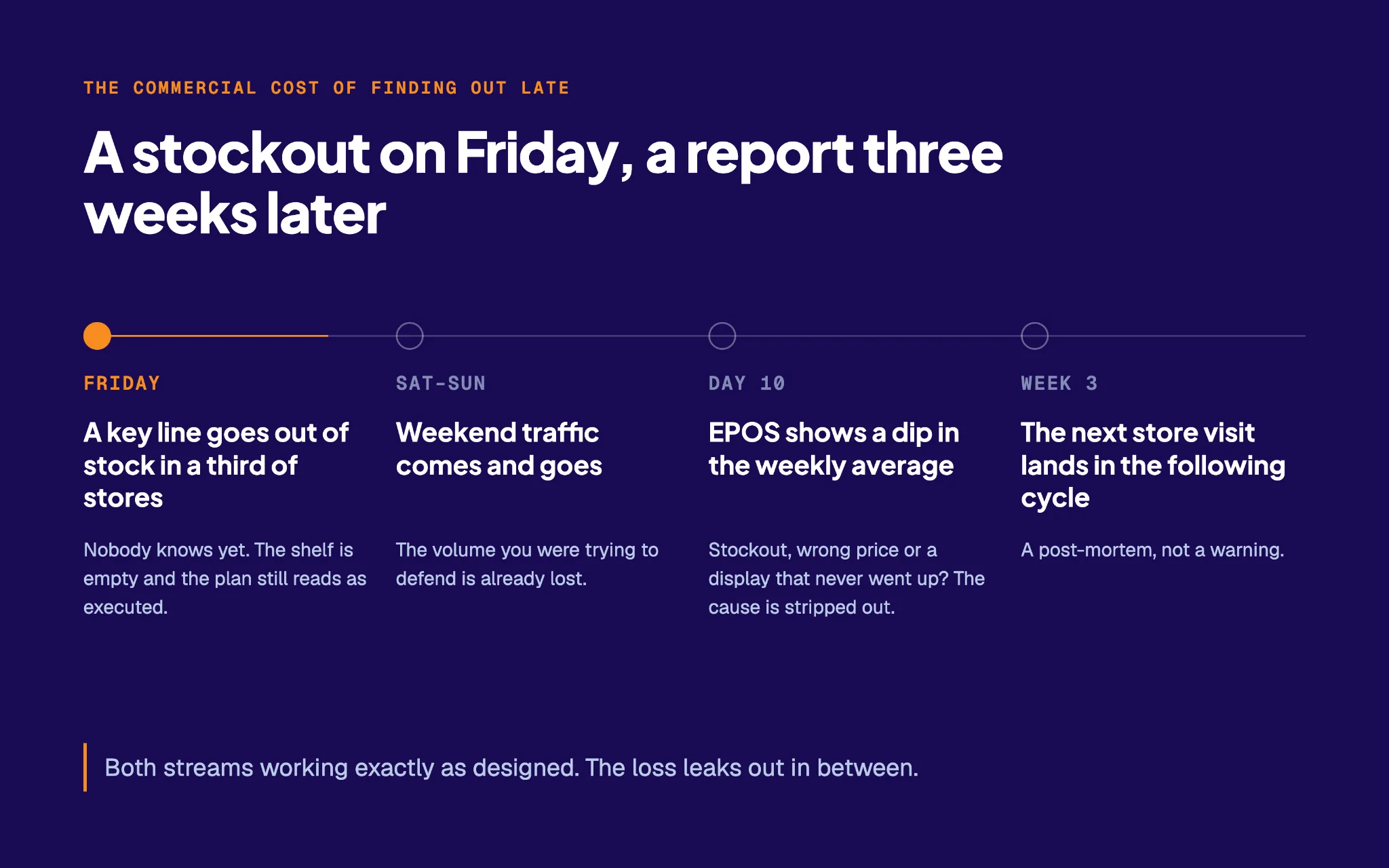
Lets take a look at a scenario. A key line goes out of stock in a third of your stores on a Friday. Under a traditional retail audit cycle, that gap might surface in a report two or three weeks later, long after the weekend traffic that would have bought it has come then gone. Nobody chose to lose that volume but it leaked out through the gap between the shelf and the report.
Both streams were working exactly as designed. The EPOS read shows a dip in that week’s average volume, ten days after the weekend closed, with nothing to say whether the cause was a stockout, a wrong price or a display that never went up. The next store visit lands in the following cycle.
Now stack that across a year with dozens of promotions, thousands of store-weeks then a steady trickle of missed availability, wrong prices then displays that never went up. Each miss is small but together they are one of the largest pools of unmanaged loss on the commercial profit and loss and almost none of it shows up as a single dramatic number, it hides inside "the audit looked fine."
The brands pulling ahead have stopped asking whether their retail audit is thorough, instead they ask whether it is fast enough to act on. That shift, from a thicker report to a quicker read, is the difference between measuring a loss then preventing one. It’s also the argument for treating audits as a driver of retail execution, not a compliance task.
What a modern retail audit should look like
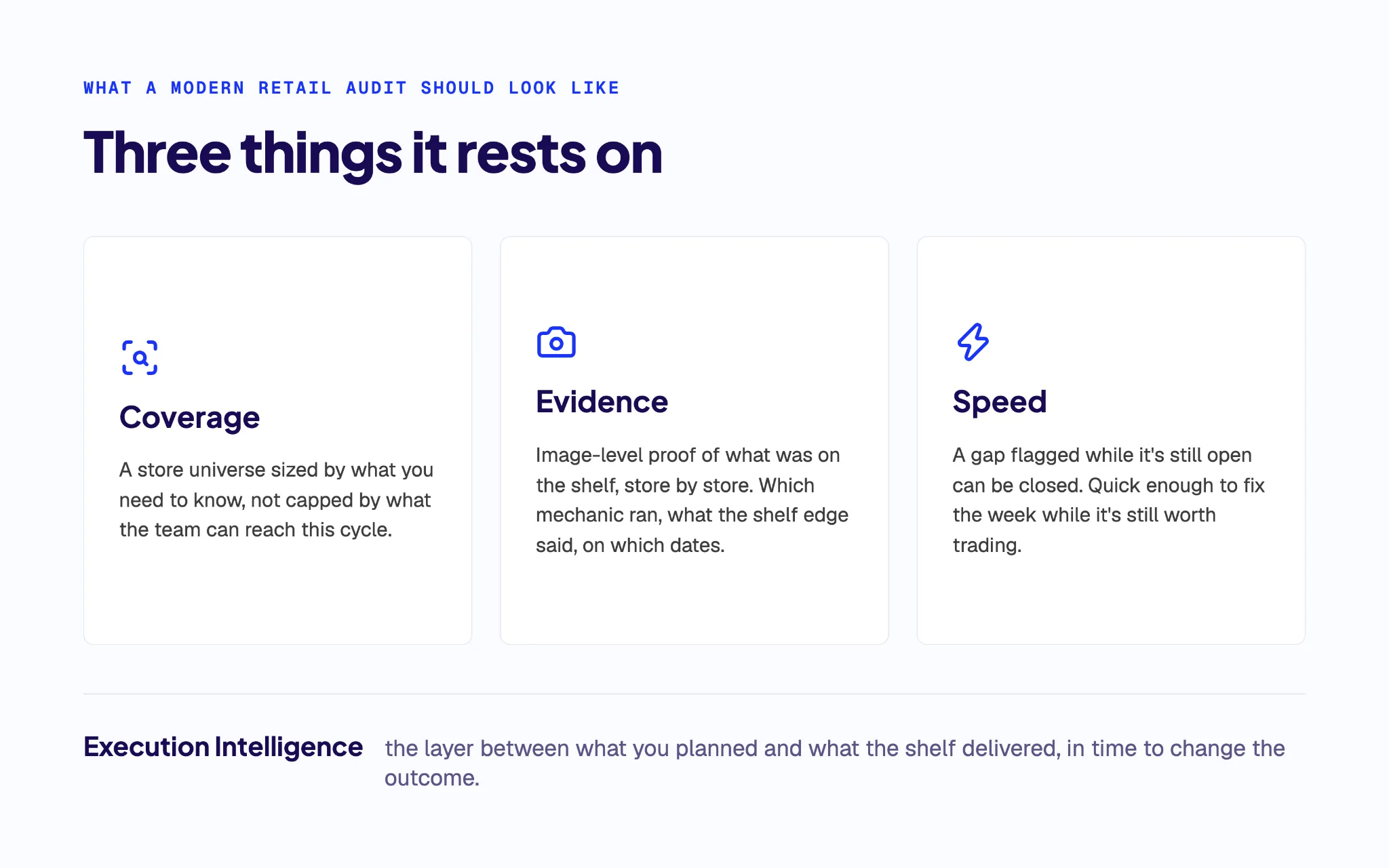
A retail audit fit for how brands trade today rests on three things.
Coverage you choose, not coverage you settle for. The aim is not a rep in every store, because the cost of that climbs faster than the value it returns. The aim is a store universe wide enough and representative enough to trust, sized by what you need to know rather than capped by what the team can reach this cycle. Image recognition works on both sides of that. It cuts the time each visit takes, so the same field team covers more ground, and it lets you pull shelf evidence from outlets a rep was never going to reach. Field time then goes where a human is genuinely needed. That is where real retail execution visibility starts, because the stores you never check are the ones costing you quietly.
Evidence, not assertion. Image-level proof of what was on the shelf, store by store, settles the debate no field note can. It also captures the output rather than the outcome: which mechanic actually ran, what the shelf edge actually said and on which dates. That is the detail a sales line can never give you. It turns a retailer conversation from an argument about whose number is right into a decision based on what the shelf actually showed. Brands that walk in with proof recover deductions instead of negotiating them.
Speed, not hindsight. A gap flagged while it is still open can be closed. The same gap reported next month is just a line in a loss column. This is the point of near real time: quick enough to get the product back on the shelf or fix the promotion while the week is still worth trading. Freeing your field team from data entry also lets them sell instead of count. AG Barr cut store audit time in half by doing exactly that.
Put those three together and the audit stops being a report you read after the fact. It becomes a live view you act on. That is what we mean by Execution Intelligence: the layer between what your commercial team planned then what the shelf and store execution actually delivered, in time to change the outcome. See how it works for the mechanics.
From audit to advantage
None of this is about adding auditing complexities or more processes, it’s about closing the gap between seeing a problem then fixing it. A retail audit that reaches you while the shelf is still wrong is worth more than a perfect one that reaches you when the quarter is closed. The commercial teams that win the shelf are not the ones with the most detailed audits, instead they are the ones who saw the gap first then acted which is where turning retail execution into measurable ROI begins.
Want to see whether your shelves are executing the way you planned, store by store, while you can still act on it? Request a walkthrough then we will show you the revenue your current retail audit cannot account for.
FAQ
What is a retail audit?
A retail audit is a check of what is actually happening in store against what a brand planned: product availability, shelf pricing, promotional displays and share of shelf versus competitors. In practice it covers two things: field visits by reps or third-party auditors, and the syndicated or EPOS sales data retailers share with their suppliers. Done well, it verifies execution across the estate quickly enough for a commercial team to act on what it finds rather than reading about it weeks later.
Isn't EPOS or syndicated data enough on its own?
It is useful but incomplete. EPOS is close to a census in modern trade and only a sample in traditional trade. It arrives as a weekly average value and volume, typically at least 10 days after the period closes. The promotional detail is superficial: a price cut is visible, the mechanic behind it is not. Most importantly, sales data is the outcome. Store execution is the output that produced it and only shelf-level evidence shows you that.
Why do traditional retail audits arrive too late?
Because they rely on periodic store visits by a limited field team. The data is a sample shaped by what the team could reach, it varies with each rep’s judgement and it takes weeks to aggregate and report. By the time it lands, the stockout, mispriced shelf or missing display it flagged has already cost the sale.
How is a modern shelf audit different?
A modern shelf audit widens the store universe deliberately rather than sampling whatever the field team could reach, uses image-level evidence instead of subjective notes and reports in near real time. That turns the audit from a record of what was lost into a tool for protecting revenue while the window is still open.

Related Resource
%20(1).png)


.svg)
Get the latest Execution Intelligence news and resources direct to your inbox
Industry insights, retail intelligence and field-tested execution playbooks, so you always know what's happening in store.
.png)

.svg)

© 2026 Neurolabs. All rights reserved

